"You also, like living stones, are being built into a spiritual house — a holy priesthood, offering spiritual sacrifices acceptable to God."
1 Peter 2:5
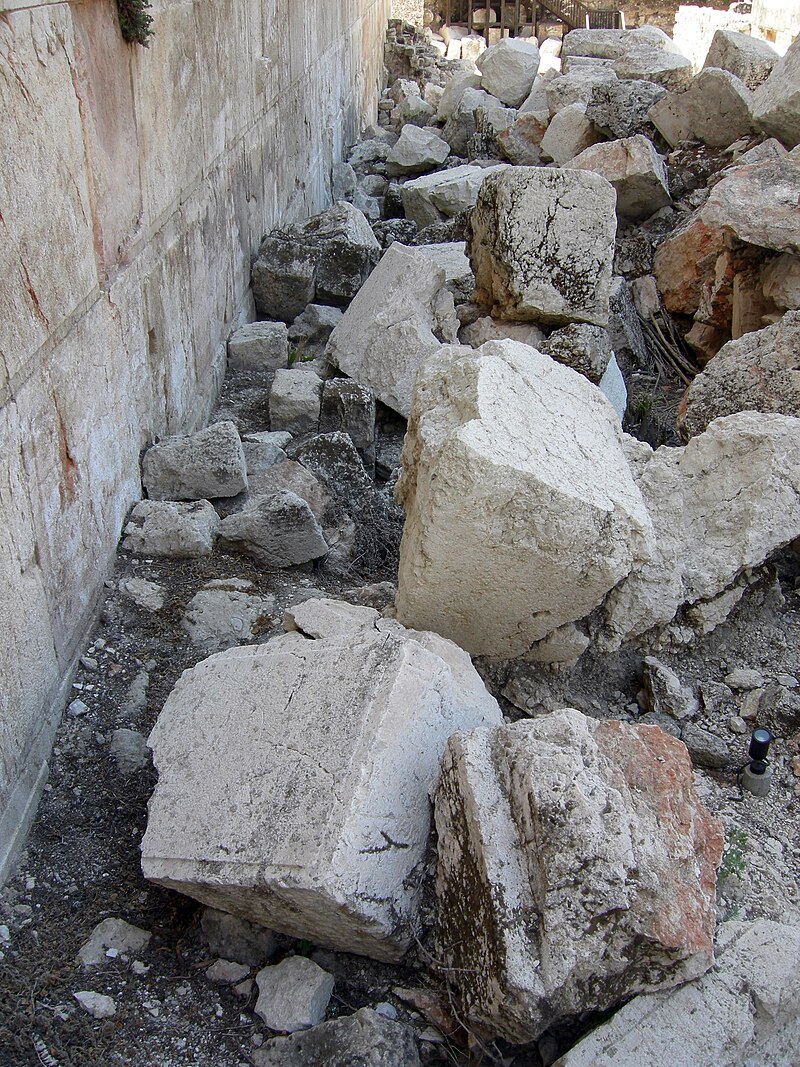
Stones from the walls of the Jewish Temple, where they fell on the 9th of Av, 70 CE
A New History of Christian Origins
When did Christianity arise? The evidence points to AD 70 — after the destruction of Jerusalem
The Central Argument
Christianity is traditionally understood to have begun in the early first century with the preaching of Jesus and the missionary work of his followers. This website explores a different possibility: that the religion we know as Christianity took shape only after one of the greatest catastrophes in Jewish history — the destruction of the Jerusalem Temple by the Romans in 70 CE.
The Temple had been the centre of Jewish religious life for centuries. Its sudden destruction ended the sacrificial system, discredited existing institutions, and created a profound theological and psychological crisis. Jews throughout the Roman world were forced to confront a troubling question: how could God allow his sanctuary to be destroyed?
This site argues that Christianity emerged as one response to that crisis. The new movement reinterpreted the disaster by presenting Jesus as the ultimate atonement sacrifice and high priest. Believers in him became a spiritual temple. In this way the loss of the Temple was transformed from defeat into a preordained victory.
Paul and the other leaders within the movement were real actors in this drama, but they all flourished after the destruction of the Temple. Paul’s letters are genuine, but they were all written after AD70. The New Testament Book of Acts is an imagined reconstruction of the history of the incipient movement based on the premise that the myth of origins (which is elucidated in the gospels) was true. The total lack of any contemporary evidence for Christians or Christianity from the middle of the first century supports the position taken by this website. And as demonstrated by numerous other lines of evidence and from sociological considerations and taking into account ancient analogous Jewish movements a reasonably detailed though of course tentative picture of what actually happened can be assembled.
“Can it be that the authorities really know that this is the Messiah [the Christ]? Yet we know where this man is from, but when the Messiah [the Christ] comes no one will know where he is from.” (John 7:26-27)
“War is the father of all and king of all; and some he has shown as gods, others men; some he has made slaves, others free.”— Heraclitus (c. 500 BCE)
Historical Context
c. 40 AD
Birth of Saul of Gischala
A boy named Saul is born to a middle-class family in Gischala, a town in the hills of northern Galilee. His father is of the sect of the Pharisees — learned, observant, and deeply rooted in Jewish law. The child will one day reshape the world.
c. 52 CE
Saul Sent to the Rabbinic School at Sepphoris
At around twelve years of age, Saul travels to Sepphoris — the great Hellenised city of Galilee, a centre of Jewish learning and Roman culture in equal measure. He excels in his studies, absorbing both the rigour of rabbinic tradition and the intellectual currents of a cosmopolitan world.
66 CE
War Breaks Out — Saul Returns to Gischala
Jewish revolt against Roman rule erupts across Judea and Galilee. Saul, alarmed for his family's safety, returns home to Gischala. There he encounters two men he will never forget: John of Gischala, a childhood acquaintance now emerging as a fierce resistance leader, and Josephus — appointed by the Sanhedrin in Jerusalem to organise the defence of Galilee, and of Gischala in particular. Three very different men, bound by the same burning world.
67–68 CE
Titus Attacks — Saul Flees to Tarsus
As Roman forces under Titus stand at the gates demanding surrender, Saul decides that escape is the best option. He takes the road north and west of Gischala, his parents in tow, their destination: Tarsus, the great trading city of Cilicia — cosmopolitan, Greek-speaking, far from the war and already possessing an established Jewish diaspora community.
70 CE
The Fall of Jerusalem & the Birth of a Myth
The siege ends. The Temple burns. But in the chaos of its final hours, a mixed crowd gathers on the Temple portico, urged there by a man who promises divine deliverance — a "false prophet," in Josephus's dismissive phrase. The Romans set fire to the portico. Most perish in the flames. The survivors scatter across the Empire carrying a story of fire, survival, and the descent of the spirit. From this catastrophe is born the myth that will become the Christian Pentecost. The false prophet himself survives. His name is Cephas.
70 CE
Saul in Antioch — Witness to the Triumph of Titus
In Tarsus, Saul has been hearing rumours: a new sect, the Christians, is spreading through the cities of Syria. Troubled, he travels south to Antioch — and arrives in time to witness the great triumphal procession of Titus, the conqueror of Jerusalem, parading the spoils of the Temple through the streets. The menorah, the sacred vessels, the humiliated prisoners. For a Pharisee who has just fled the destruction of everything he held holy, it is a sight that burns itself into memory.
71 CE
The Great Triumph at Rome
Titus celebrates a second, even greater triumph in Rome, together with his father the emperor Vespasian and his brother Domitian. Coins are struck with the words IVDAEA CAPTA, "Judea captured".
71–72 CE
The Persecutor — Saul at Yavneh
As a strict Pharisee, Saul regards the new Christian sect as a dangerous heresy — a blasphemy against the very Judaism now struggling to survive its catastrophe. He involves himself in its persecution. Travelling via his childhood hometown of Gischala, now quiet and depopulated, he makes his way to Yavneh — Jamnia — where Yochanan ben Zakai has established a new centre of Jewish learning to salvage and preserve what was lost when Jerusalem was sacked. There Saul discusses the Christian problem with the leadership. Gamliel II, the Nasi, grants him letters of authority: he is to travel to Damascus and stamp out the heresy there.
73 CE
The Fall of Masada
Masada, the last major Jewish stronghold against Rome, fell after a prolonged siege. Roman forces constructed a massive siege ramp still visible today, thereby breaching the fortress defences. Its fall marked the effective end of organised Jewish resistance to Rome during the first Jewish revolt.
73 CE
Damascus — Collapse, Conversion & Flight
In Damascus, armed with his letters of authority, Saul pursues the Christians. Then something breaks. Whether from grief, exhaustion, theological crisis, or something stranger — he suffers a profound mental collapse. He converts to the very faith he came to destroy. With his new faith he takes a new name: Saul — his Jewish name — becomes Paul, a Latin name meaning "small." It is a deliberate choice, the self-deprecating signature of a man who will call himself "the least of the apostles." His former colleagues are appalled. They name him Gehazi after the treacherous servant of Elisha the Old Testament prophet, an apostate. He is forced to flee for his life. He escapes the city by night, lowered over the walls in a basket by friends, disappearing into Arabia perhaps even visiting Sinai where he believed that Moses had received the first covenant, then returning to Damascus when the immediate danger had subsided.
73 CE
Jerusalem — Meeting with Cephas and James “the brother of the Lord”
Saul makes his way to Jerusalem — a city where weeds and vermin now multiply unhindered, where makeshift shelters and shops serve the needs of the impoverished community of hardy survivors. He stays with Cephas: the false prophet of the portico, the man who led the crowd into the fire and walked out alive, now the living heart of the new movement. The apostle says in one place that Cephas was the first person to see the risen lord. Paul listens to his testimony and after fifteen days departs for regions north where the new Christians proclaim joyously, “The one who formerly was persecuting us is now proclaiming the faith he once tried to destroy.”
75–79 CE
Josephus Publishes Wars of the Jews
Writing in Rome under Flavian patronage, Josephus publishes his account of the Jewish revolt without once mentioning the word “Messiah” (Hebrew: Moshiach. Greek: Μεσσίας) or “anointed one” that is χρỳστός (Christ). In it he makes only one obscure reference to the new sect and its "false prophet" — a silence that speaks volumes about the movement's visibility at this time.
77 CE
Pliny the Elder Completes Naturalis Historia
Pliny the Elder completes his encyclopaedic Natural History, which mentions the ascetic Jewish sect of the Essenes but makes no mention of the Christians — further evidence that the movement had not yet achieved the prominence it would later claim.
79 CE
Vesuvius Erupts — Vespasian Dies, Titus Becomes Emperor
The eruption of Vesuvius buries Pompeii and Herculaneum. For many it signals the end of the world. Paul incorporates the catastrophe into his eschatology as the "wrath from heaven" (Romans 1:18). Vespasian dies and Titus, conqueror of Jerusalem, becomes emperor.
81 CE
Titus Dies — Domitian Becomes Emperor
Titus dies after only two years as emperor. His younger brother Domitian succeeds him, ushering in a reign that will prove far more hostile to both Jews and Christians.
84 CE
Paul's Second Visit to Jerusalem
"Fourteen years after" the destruction of the Temple (Galatians 2:1), Paul visits Jerusalem for the second time. He confirms the viability of his gospel and concedes the legend of "Peter" as apostle to the Jews. He agrees to collect money from the Gentile churches to support the poor saints in Jerusalem, then confronts Cephas in Antioch on his way back to Ephesus.
c. 86 CE
Paul Writes to the Romans — Travels to Rome
Paul writes the letter to the Romans and travels to Rome for the first time, bringing his mission to the very heart of the empire.
c. 92 CE
Death of Paul
Paul dies quietly while under house arrest in Rome for the second time and is buried in an unmarked grave. The movement he built will outlive him by millennia; the man himself will be largely forgotten behind the myth he created.
96 CE
Domitian Assassinated — Nerva Emperor — Clement First Bishop of Rome
Domitian is assassinated and Nerva becomes emperor, easing the persecution of Christians. Clement becomes the first bishop of Rome and writes with authority to Paul's "ancient" church at Corinth with a call for unity — his letter placing both Clement and the Corinthian community firmly in the generation that knew Paul personally.
98 CE
Nerva Dies — Trajan Becomes Emperor
Nerva dies after a brief reign and is succeeded by Trajan, under whose rule the empire reaches its greatest territorial extent.
111 CE
Pliny the Younger Writes to Trajan on the Christians
Appointed governor of Pontus and Bithynia, Pliny the Younger writes to the emperor Trajan seeking guidance on how to deal with the Christians — one of the earliest non-Christian references to the movement, confirming that by this date it has become a matter of imperial administration.
"You also, like living stones, are being built into a spiritual house — a holy priesthood, offering spiritual sacrifices acceptable to God."
1 Peter 2:5
Stones from the walls of the Jewish Temple, where they fell on the 9th of Av, 70 CE
Geography
Key locations in the world of Paul and the first-century Jewish homeland
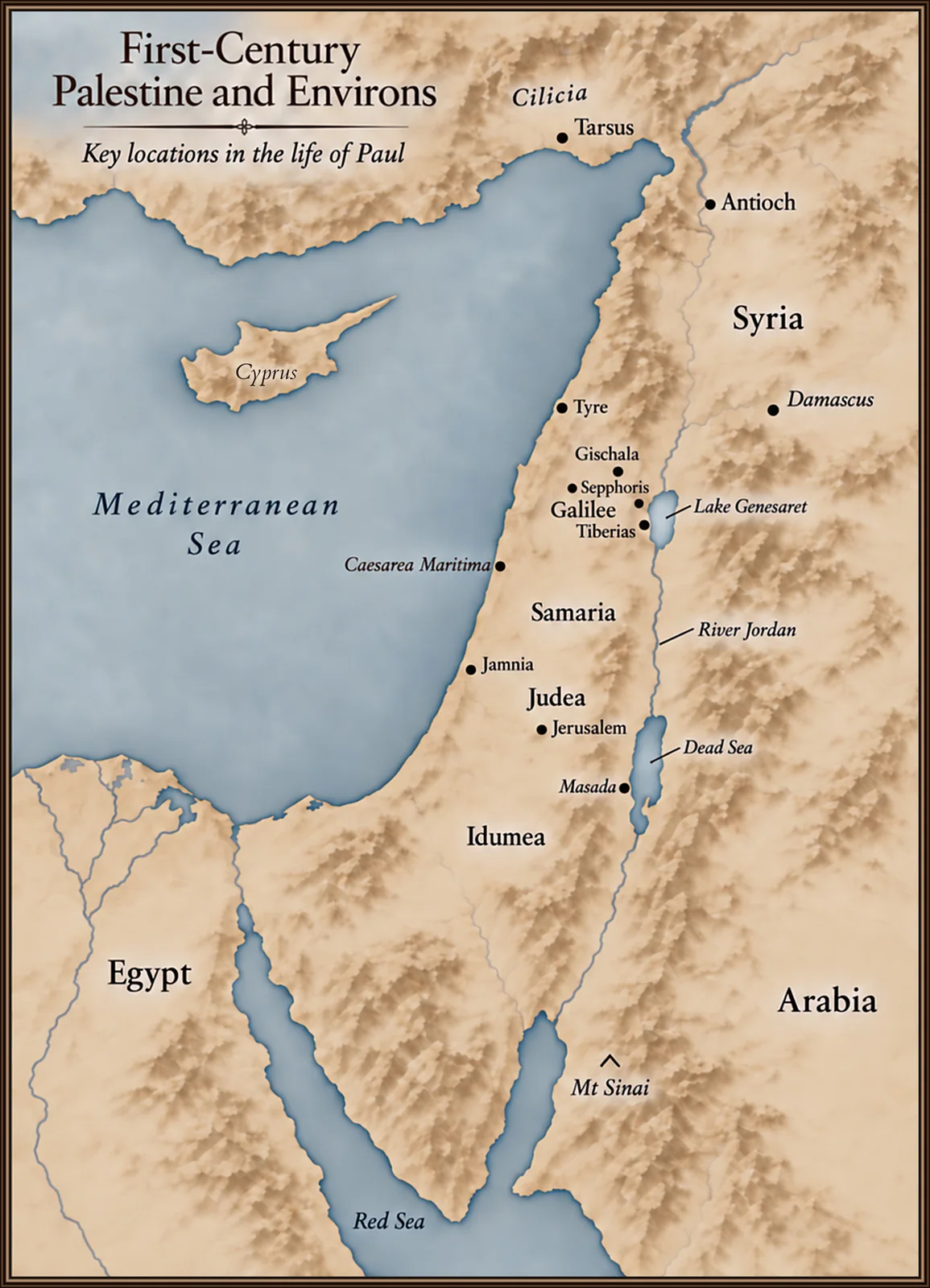
Palestine and Environs
Key locations in the life of Paul
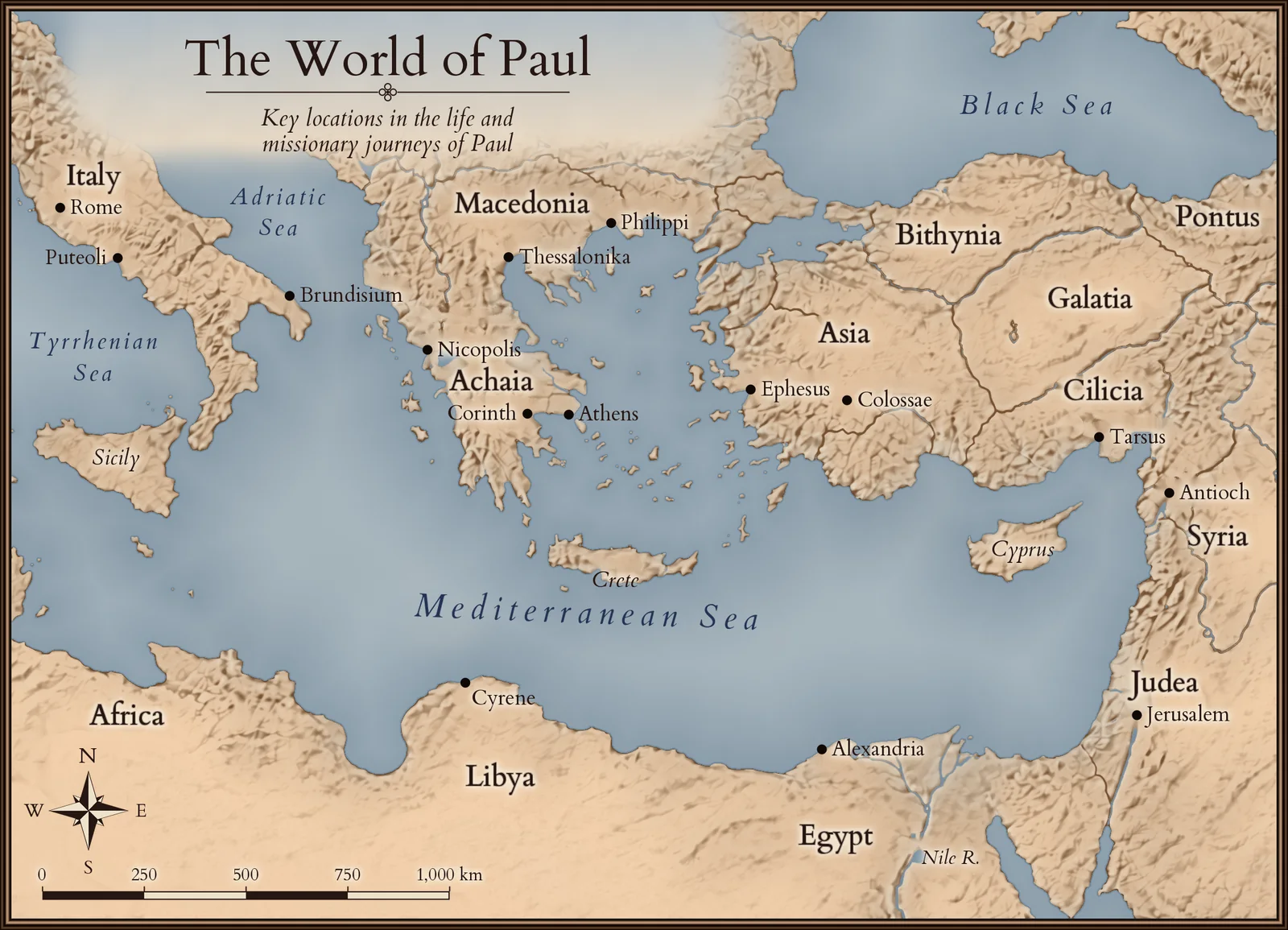
The World of Paul
Key locations in his life and missionary journeys
Three Pillars of the Argument
Every major episode in the life of Jesus can be traced to a passage in the Hebrew scriptures. The virgin birth, the flight to Egypt, the entry into Jerusalem, the betrayal for thirty pieces of silver, the crucifixion — each is a fulfilment of prophecy because each was written as a fulfilment of prophecy. Jesus was not a man around whom scripture gathered. He was a figure assembled from scripture, constructed to make sense of the catastrophe of AD 70.
The evidence lies not in Acts — a second-century exercise in imagining how Christianity might have begun if its founding myth were true — but in Paul's own letters and in Matthew's text itself. The theology of the cross, of justification by faith, of a universal religion open to Gentile and Jew alike: these are Pauline ideas, present in all his epistles. Matthew did not record what Jesus taught. He took what Paul taught and placed it in the mouth of a character assembled from the Septuagint — a Jewish prophet for a Greek world, preaching a message his author had inherited from Saul of Gischala. Whether Matthew was written with Paul's direct knowledge and blessing — as this thesis considers probable — or composed by a later disciple working within the Pauline tradition, we cannot say with certainty. What we can say is that the theological fingerprints are unmistakably his.
Paul's own letters reveal the mechanism. He instructs his congregations to imitate him as he imitates Christ — collapsing the distance between himself and his saviour to a single degree of separation. Christ is Paul perfected, Paul idealised, Paul freed from the contingencies of history. When Paul writes that he no longer lives but Christ lives in him, he is not speaking metaphorically. He is describing the psychological process by which a real man became a mythological one.
The Man Behind the Gospel
Whatever the precise origins of the New Testament texts, one conclusion emerges with clarity: the survival and triumph of Christianity was not inevitable. It required a person of extraordinary gifts to take a fragile post-war sect and forge it into a world religion. That person was Paul.
The conventional account of Christian origins places its founding in the life, death, and resurrection of Jesus of Nazareth — a historical figure whose followers spread his teachings across the Roman world. This thesis argues that account is a myth, and that the man called Jesus never existed outside the minds of those who needed him to.
Jesus was not a real person. He was a construction — assembled from Old Testament prophecy, from Messianic expectation, and above all from the life, miracles, and teachings of one real, extraordinary man: Saul of Gischala, known to the world today as the Apostle Paul.
Paul himself declared: "Imitate me, as I imitate Christ." This thesis takes him at his word — and reverses the direction of imitation. Christ imitated Paul. The miracles performed across Greece and Asia Minor, later recorded in the gospels as the works of Jesus, were Paul's miracles first. Jesus was Paul's alter ego — the idealised, timeless self projected backwards into history.
The Gospel of Matthew, the first gospel written, reveals this most clearly. It is not a Jewish document. It is a Greek story — shaped by Hellenistic literary conventions, structured around Septuagint prophecy, and set in an Israel its author knew largely from the reports of others. The Jesus it presents is not a memory. He is a portrait of Paul, idealised, transformed and placed in a faraway land at a time in the imagined past.
Paul almost certainly wrote the majority of the New Testament — aided by amanuenses who gave his dictated letters their final literary form. The case extends, tentatively, to Hebrews: its theology is deeply Pauline even where its style diverges. Clement of Rome, writing in the final decade of the first century, knew Paul personally and demonstrates clear familiarity with the synoptic gospels — placing both Paul and the gospel tradition firmly within the same generation, the same circle, and quite possibly the same conversation.
Paul took the raw material of the post-Temple crisis — the desperate need for a new relationship with God, stripped of sacrifice and priesthood — and gave it an intellectual architecture of extraordinary power. Justification by faith. The universal church. The mystical body of Christ. Death and resurrection as the pattern of the spiritual life. These were not obvious conclusions from the rubble of AD 70. They were the innovations of a single, restless, visionary mind working at the outer edge of Jewish thought.
Genius alone does not build institutions. Paul was also a formidable organiser — establishing communities across the Greek world, appointing local leadership, maintaining correspondence across vast distances, and managing the fierce internal disputes that threatened to fracture the movement before it had taken root. The network he built outlasted him by centuries. Without it, the ideas would have died with their author.
Nor did Paul work alone. He was surrounded by a remarkable cohort of younger disciples — men and women who carried letters, planted churches, suffered imprisonment, and extended the mission into territories Paul never reached. Prisca and Aquila. Timothy. Titus. Phoebe. The movement was collaborative, networked, and surprisingly egalitarian in its earliest form. Paul provided the vision and the drive; others provided the legs.
The end, when it came, was not dramatic. In Rome, under house arrest, Paul found himself increasingly alone. Some companions had drifted away, disillusioned by the stubborn failure of the Second Coming to arrive — a promise that was becoming harder to defer with each passing year. Others found themselves caught between two uncomfortable truths: the popular myth of Christian origins was already hardening into something that bore little resemblance to what they knew had actually happened, and the gap between the two was not one they could safely acknowledge.
Paul had become, in a profound sense, a victim of his own success. The religion he had conjured into existence was already outgrowing its creator — taking on a life, a narrative, and an institutional momentum he could no longer control. There is a final irony that the thesis cannot pass over. The old man in Rome, watching his movement slip beyond his control, turned in his last years to heresy-hunting — denouncing false teachers, warning his communities against deviant doctrine, demanding conformity to his gospel and no other. It was, of course, exactly how his career had begun: the young Pharisee armed with letters of authority, riding out to stamp out a heresy in Damascus. The firebrand who had torn Christianity open to the world ended his days trying to nail it shut.
His particular fury was reserved for the Judaisers — those within the movement who sought to draw it back towards its Jewish roots, accepting Jesus as Messiah while insisting on circumcision, dietary law, and the observance of the Sabbath. To Paul this was not a moderate position or a reasonable compromise. It was a betrayal of everything he had built. His entire theological vision rested on the radical proposition that faith in Christ had superseded the Law entirely — that the old covenant was finished, that Gentile and Jew stood equal before God without precondition. To reimpose the Law was, in Paul's eyes, to unsay everything. The Epistle to the Galatians — perhaps the most ferocious letter he ever wrote — is essentially one long, barely contained scream of rage against exactly this tendency. That such a battle still had to be fought in his final years suggests the Judaisers were stronger than the eventual shape of Christianity would lead us to believe. Paul won. But it was not easy, and it was not certain. The circle was complete — and the man at its centre probably knew it.
Throughout this thesis, claims about Pauline authorship are distinguished carefully between what the evidence compels, what it suggests, and what remains genuinely open. The case for Paul as the dominant architect of the New Testament is strong. The case for any single text — Hebrews, the pastoral epistles — requires individual argument. Certainty is claimed only where the evidence demands it.
The Scholarly Case
52 items of evidence for the late appearance of Christianity
By examining the list of the fourth century heresiologist Epiphanius1, we can see that all early Jerusalem bishops had short careers (average 3 to 5 years) with the sole exception of the second bishop named Symeon, who oddly has a career of at least 30 years, and lived according to Eusebius, to the age of 120. We suggest that this anomaly has been caused by the early church historians attempting to fit a limited list of names into a long and artificial time frame.
According to Hegesippus, Symeon was betrayed by some heretics when he was 120 years old.2 The number 120 seems to have been chosen for the lifespan of Symeon from the post-diluvian upper limit of age referenced in Genesis, "My spirit shall not abide in mortals forever, for they are flesh; their days shall be one hundred twenty years." (Genesis 6:3)
Notes
1. Panarion, Book 2.v.20.
2. "Some of these heretics, forsooth, laid an information against Symeon the son of Clopas, as being of the family of David, and a Christian. And on these charges he suffered martyrdom when he was 120 years old, in the reign of Trajan Caesar, when Atticus was consular legate in Syria." Hegesippus, *Commentaries on the Acts of the Church, quoted in Eusebius, Ecclesiastical History*, Book 3.32.
_
This argument examines the Jerusalem Bishop List provided by early church historians (Eusebius, Epiphanius, and Hegesippus) to demonstrate a chronological anomaly. It suggests that the church "stretched" a small number of names across a large historical gap to create a continuous lineage back to the time of Jesus, resulting in the mathematically improbable lifespan of Symeon.
The strength of this argument is its statistical improbability. The list of the first fifteen bishops of Jerusalem (all of whom were "of the circumcision") is forced to cover the period from the Crucifixion (c. 30 CE) to the Bar Kokhba Revolt (135 CE). To make the math work, church historians assigned almost all bishops incredibly short terms, except for Symeon son of Clopas, who is credited with a reign of roughly 30-40 years and a lifespan of 120 years. The choice of "120" is a "red flag" for historians, as it is the exact maximum human lifespan decreed by God in Genesis 6:3. This suggests the number is a hagiographic trope used to fill a "chronological hole" rather than a biological reality.
The weakness is that traditionalists view these long lives as a sign of divine favour or "apostolic longevity," similar to the long-lived figures of the Old Testament. They argue that the short terms of the other bishops were due to the extreme instability and persecution in Jerusalem during the 1st and 2nd centuries. However, for a historian, the "Symeon Anomaly" looks like a literary bridge constructed to link the post-70 CE movement back to the era of James and Jesus.
If the orthodox thesis--that there was a continuous, unbroken succession of bishops in Jerusalem from 33 CE onwards--were correct, we should see:
• Actuarial Consistency: A more natural distribution of lifespans and tenures. Instead, we see a "cluster" of short-lived leaders and one "super-centenarian" who conveniently fills the gap between the Fall of Jerusalem (70 CE) and the reign of Trajan.
• Administrative Records: Contemporary records from the 1st century should mention these bishops. Instead, they only appear in the writings of historians like Eusebius (4th century) who were actively trying to construct a coherent "history" for a now-dominant state religion.
• Separation from Mythology: The ages of leaders should not perfectly mirror symbolic biblical numbers. The "120 years" of Symeon makes him a New Moses, which is a theological statement, not a historical census.
John is recorded in Galatians 2:9 along with Cephas and James as being one of the pillars of the church in Jerusalem. Tradition would place John as being active from about 30, that is the supposed year of Jesus' death. Notwithstanding the fact that the average life expectancy in ancient Roman times was less than 30 years1 we have John (if it is the same "John") still active in the reign of Trajan, that is after the year 98.
Irenaeus says,
Then, again, the Church in Ephesus, founded by Paul, and having John remaining among them permanently until the times of Trajan, is a true witness of the tradition of the apostles.2
Eusebius records that John, after the death of Domitian in 96, was nimble enough to ride a horse and chase down a youth who was attempting to flee from him.3
The legendary longevity of John has echoes in the fourth gospel, where the writer of what appears to be an appendix, skilfully weaves the well-known "longevity" of John into the story. (John 21:20-25) This also indicates that the gospel or at least the appendix was written after John's death.
Notes
1. Stark, 1996, p.155.
2. Irenaeus, Heresies, Book 3.3.4.
3. Ecclesiastical History, Book 3.23.
_
This argument parallels the "Symeon Anomaly" (Item 1) by highlighting the biologically improbable longevity assigned to the Apostle John. It suggests that, like the Jerusalem bishop list, John's "90-year career" is a literary device used by late first and early second century writers to bridge the historical chasm created by the Jewish-Roman War.
The strength of this argument lies in the actuarial reality of the 1st century. In a world where the average life expectancy was under 30 and reaching 60 was considered extreme old age, a man active in AD 30 who is still "nimble enough to ride a horse" and lead a major church in AD 98 is a statistical miracle. The appendix of the Gospel of John (Chapter 21) actually admits that a rumour had spread that this disciple "would not die," which implies the community was struggling to explain how a man from the "Jesus generation" could still be alive so long after the fact. From a revisionist perspective, this "longevity" is a narrative fix to connect the post-war Church in Ephesus (Point 7) back to a legendary pre-war founder.
The weakness is the possibility of "The Two Johns." Even in antiquity, writers like Papias distinguished between "John the Apostle" (the son of Zebedee) and "John the Presbyter" (the Elder). It is possible that the long-lived leader in Ephesus was a younger disciple who shared the name, and later tradition conflated the two to create a direct apostolic link. However, the Church fathers (Irenaeus, Eusebius) insist they are the same person to guarantee "Apostolic Succession."
If the orthodox thesis--that John the Apostle lived a natural 100-year life--were correct, we should see:
• A Natural Decline: Instead of a "nimble" horseman at age 90+, we should see records of a frail, perhaps incapacitated leader. Instead, the legends (like the one in Eusebius) portray him with superhuman vitality to preserve his authority.
• Early 1st-Century Witnesses: There should be more secular or non-Christian mentions of this "pillar" during the mid-1st century. Instead, John remains a shadow in the historical record until he suddenly emerges as a powerhouse in Asia Minor after the fall of Jerusalem.
• Consistency in Acts: The Book of Acts focuses almost entirely on Paul after Chapter 15. The "Pillars" in Jerusalem (John included) vanish from the narrative long before the war, only to "reappear" in tradition once the war is over.
Polycarp, the bishop of Smyrna, was martyred in the year 155 at the earliest.1 Assuming he was 80 when he died, he would have been 20 in the year 95. This dating places Polycarp as contemporary with the apostles at the end of the first century. Irenaeus, bishop of Lyons in the latter half of the second century writes,
Polycarp, too, was not only instructed by the apostles, and conversed with many who had seen Christ, but was also appointed Bishop of the Church in Smyrna by apostles in Asia, whom I also saw in my early youth, for he tarried (with us on earth) a very long time.2
Notes
1. Some have proposed later dates, for example Eusebius, 166-7CE. Parvis, 2006, p.105ff.
2. Irenaeus, Against Heresies, Book 3.3.
_
This argument follows the pattern of the "Apostolic Bridge" seen in the cases of Symeon (Item 1) and John (Item 2). It examines Polycarp of Smyrna, a pivotal figure in the mid-2nd century, to show how early Church tradition used "cascading longevity" to link the 2nd-century Church directly to the 1st-century apostles.
The strength of this argument lies in the chain of custody it creates. Irenaeus (writing c. 180 CE) claims to have known Polycarp, who in turn allegedly knew the Apostles. This creates a "three-handshake" link to Jesus: Jesus → Apostles → Polycarp → Irenaeus. However, as the 4th point demonstrates, the math is precarious. If Polycarp was martyred in 155 CE at age 86 (the age he cites at his trial), he was born in 69 CE--the very height of the Jewish War. He would have been an infant when Jerusalem fell and a young man in the 90s. While biologically possible, the claim that he was "instructed by the apostles" (plural) relies on those apostles (like John) having the "legendary longevity" discussed in Point 2.
The weakness is that, unlike the 120-year-old Symeon, Polycarp's lifespan of 86 years is entirely realistic. The tension arises not from Polycarp's age, but from the identity of his teachers. If the "Apostles" were actually post-70 survivors in the Decapolis or Asia Minor (Item 6), then Polycarp's education fits a revisionist timeline perfectly. The "unbelievable" element only appears if one insists these Apostles were already leaders back in the 30s CE.
If the orthodox thesis--that Polycarp was the final link in an unbroken chain from AD 30--were correct, we should see:
• Consistent Apostolic Presence in Asia Minor: There should be evidence of multiple apostles living in Smyrna or Ephesus throughout the 60s and 70s. Instead, we see a "vacuum" during the war years, with the apostles only "surfacing" in Asia Minor to instruct Polycarp after the destruction of Judea.
Quadratus who wrote an apology for Christians to the emperor Hadrian (117-138) is quoted as saying,
But the works of our Saviour were always present, for they were genuine---those that were healed, and those that were raised from the dead, who were seen not only when they were healed and when they were raised, but were also always present; and not merely while the Saviour was on earth, but also after his death, they were alive for quite a while, so that some of them lived even to our day."1
Jerome concurs and adds that Quadratus was a disciple of the apostles.2
Notes
1. Ecclesiastical History, Book 4.3.
2. Jerome, De Viris Illustribus 19.
_
This argument utilizes the testimony of Quadratus to suggest that the gap between the "time of Jesus" and the early second century was much shorter than the orthodox timeline allows, or that the "miracle witnesses" are a literary device used to stretch history.
The strength of this argument is its focus on a glaring chronological stretch. Quadratus wrote his apology around AD 124-125. If Jesus died in AD 30, a person healed by him (who was old enough to be "present" and "seen") would have to be nearly 110 to 120 years old to be alive in "the day" of Quadratus. Like the cases of Symeon and John, this relies on a recurring "120-year" motif that defies ancient actuarial reality. It suggests that Quadratus was either using a rhetorical flourish or that his "Jesus" existed much closer to his own time (post-AD 70).
The weakness is the ambiguity of the phrase "even to our day." In ancient rhetoric, this could mean "within living memory" or "until very recently," rather than "they are sitting in the room with me right now." Additionally, Jerome's later commentary (4th century) often added "apostolic" pedigrees to earlier writers to bolster their authority, which may not reflect Quadratus's actual historical context.
If the orthodox thesis--that Jesus's ministry occurred in the early 30s and his witnesses naturally survived into the 120s--were correct, we should see:
• Identifiable Witnesses: Quadratus (or Eusebius) would ideally name these long-lived individuals. In a community that prized "living voices," a 115-year-old witness to a miracle would be a massive celebrity. Instead, they remain anonymous "some of them".
• Medical/Historical Curiosity: Roman records or intellectual contemporaries (like Pliny the Younger or Plutarch) would likely remark on a specific sect in Judea/Asia Minor known for extraordinary longevity or "resurrected" elders.
• Earlier Attestation: If these witnesses lived until AD 125, they would have been in their prime during the time of Nero (AD 60s). We should see them referenced in the letters of Paul or other mid-first-century documents as the "living proof" of the movement.
Philip of Side quoting Papias, says, "Concerning those who were raised from the dead by Christ, [he relates] that they lived until Hadrian."1
According to the gospel of Mark, Jairus' daughter who was raised from the dead by Jesus, was twelve years old. (5:42) Assuming Jesus performed the miracle in the year 30, she would have lived to be more than 99. Other adults such as Lazarus (John 11) and the young man from Nain (Luke 7) would have been well over a hundred when Hadrian became emperor in 117. While not accepting that anyone was actually raised from the dead, the passage speaks of people much more recently touched by Jesus, however that may be interpreted. It points to an origin or source for the stories much more recent than 30 CE.
Notes
1. Philip of Side, Fragment 4.6.
_
This argument reinforces the "longevity anomaly" seen in the previous points, suggesting that the legendary survival of Jesus's miracle recipients into the 2nd century indicates a much later historical starting point than AD 30.
The strength of this argument lies in its biological absurdity. If Jesus raised Lazarus or the daughter of Jairus in the early 30s, and they were still alive in the reign of Hadrian (AD 117-138), they would have to be between 100 and 120 years old. Like the claims about Symeon (120) and John (100+), this persistent "100-year gap" across multiple witnesses suggests that early writers were desperately trying to bridge a historical void. The more logical explanation--if we assume these traditions contain a kernel of history--is that the events themselves were believed to have happened much closer to the time of Hadrian.
The weakness is that Papias (and Philip of Side) may be engaging in hagiographical hyperbole. In the 2nd century, claiming that "eyewitnesses survived until recently" was a standard rhetorical tool used to validate oral tradition. Rather than proving a late origin, it might simply prove that 2nd-century Christians felt a need to claim "direct links" to a past that was rapidly fading, regardless of the mathematical impossibility.
If the orthodox thesis--that Jesus died in AD 30 and these witnesses were truly ancient survivors--were correct, we should see:
• A "Generation Gap" in Leadership: We should see a distinct secondary generation of leaders who took over in the 60s and 70s. Instead, the tradition skips from the Apostles directly to "living links" who magically survive until the 120s.
• Veneration of the "Risen": Individuals like Lazarus, who supposedly conquered death twice, would be the most famous figures in the early church. We should find records of their travels, teachings, or tombs dating to the mid-to-late 1st century.
• Realistic Aging: Christian literature from the 90s (like 1 Clement) should mention that the "last witnesses are now dying off." Instead, Quadratus and Papias claim they are still around in the 120s.
We can reasonably surmise that the first Christians were Jewish Christians who were later labelled heretics--their name, Ebionites signifies "poverty". There was no leader called "Ebion". But the other information provided by the Christian heresiologist, Epiphanius is instructive. Epiphanius says,
Their origin [the Ebionites] came after the fall of Jerusalem. For since practically all who had come to faith in Christ had settled in Peraea then, in Pella, a town in the 'Decapolis' the Gospel mentions, which is near Batanaea and Bashanitis---as they had moved there then and were living there, this provided an opportunity for Ebion.1
However, the Acts and the gospels paint an entirely different picture. They have Paul and the other apostles preaching and establishing churches all around the Mediterranean, converting swathes of Asia Minor well before Jerusalem was taken. But Epiphanius records that practically all who had come to faith in Christ had settled in Peraea, at the time of the fall of Jerusalem in 70. And not only this---the Ebionites, that is the Jewish Christians, came after the Jewish War.
It is hardly coincidental that the region where Jesus allegedly preached and healed, the setting for the gospel stories, the Decapolis in Galilee is the same region that the very first Christians called home.
Notes
1. Epiphanius, Panarion 30.2.7.
_
This argument highlights a fundamental discrepancy between the Acts of the Apostles (which describes a global, pre-70 CE expansion) and the records of early Church historians like Epiphanius. It suggests that the "birth" of Christianity was actually a localized, post-war phenomenon centred in the Decapolis--the same region where the Gospel stories were later set.
The strength of this argument lies in its geographic and historical specificity. Epiphanius, despite writing as a critic of "heretics", preserves a tradition that "practically all" believers settled in Pella (Peraea) specifically after the fall of Jerusalem. This aligns with the "Refugee/Survivor" model seen in a later item. If the first Christians were essentially war refugees from Judea who regrouped in the Decapolis, it explains why the Gospels (like Mark and Matthew) are so deeply rooted in the geography of the Galilee-Decapolis corridor. It suggests the "Jesus of Galilee" narrative was developed by people living in that region after 70 CE to make sense of their displacement.
The weakness is the orthodox "Flight to Pella" tradition. Eusebius and other Church fathers argue that the Christians left Jerusalem before the siege because of a divine revelation. In this view, the move to Pella wasn't the beginning of the movement, but a strategic survival tactic for an already established group. However, Revisionists note that if a global Mediterranean mission were already underway as Acts claims, there would be no reason for "practically all" believers to be huddled in a single Decapolis town after the war.
If the orthodox thesis--that the Mediterranean mission preceded the war--were correct, we should see:
• Thriving Diaspora Centres: After 70 CE, the centres of Christianity should be Ephesus, Antioch, and Rome---the places where Paul allegedly spent decades. Instead, early historians point to the Decapolis (Pella) as the primary hub of the original faith in Christ.
• Ebionite Primacy: If the "Ebionites" (The Poor) were the original group in the Decapolis, and they appeared after the war, then the "poverty" of their name likely refers to their status as destitute refugees who lost everything in the Roman destruction, rather than a voluntary spiritual choice made in the 30s.
A reading of Jerome implies that Paul was active *after the Jewish War. In his Lives of Illustrious Men*, he declares that: "When this [town of Giscalis/Gischala] was taken by the Romans (c. 67 CE)1 he [Paul] removed with his parents to Tarsus in Cilicia."2 While scholars have attempted to interpret this passage as referring to an earlier Roman occupation3, the following passage leaves little doubt as to which Roman occupation Jerome is referring to.
They say that the apostle Paul's parents were from the region of Giscala in Judea; and that when the whole province was laid waste by the hands of the Romans, and the Jews were dispersed into the world, they were moved to the city of Tarsus in Cilicia. (Commentary on Philemon)
If we accept the witness of Jerome, our scenario has Paul experiencing firsthand the effects of the War on himself and his immediate family. Jerome's testimony written from the safe distance of three hundred years after the religion's inception seems to be drawing on an ancient but quite possibly true tradition.
Notes
1. Wars of the Jews, 4.84-120.
2. De Viris Illustribus, 5.
3. Murphy-O'Connor, 2007, p.16-20; Saffrey, 2007, p.314.
_
This argument utilizes a specific biographical tradition preserved by St. Jerome (c. 347-420 CE) to suggest that the Apostle Paul's origins and subsequent career are inextricably linked to the Jewish-Roman War (66-70 CE). By placing Paul's displacement in the context of the Roman conquest of Gischala, Jerome inadvertently creates a timeline where Paul is a post-war figure.
The strength of this argument is its reliance on one of the most learned and resourceful historians of the early Church. Jerome had access to libraries and oral traditions now lost to us. His explicit statement that Paul's family was moved when "the whole province was laid waste" and "Jews were dispersed" is a textbook description of the aftermath of the Flavian conquest of Galilee (67 CE) and Judea. If Paul were a young man during this displacement, his entire ministry would necessarily fall between 70 and 100 CE, aligning perfectly with the Revisionist thesis.
The weakness is the chronological tension with Jerome's other writings. Elsewhere, Jerome adheres to the orthodox view that Paul was executed under Nero (d. 68 CE). Standard scholarship views this "Gischala tradition" as a confused memory of an earlier, unrecorded Roman skirmish or a simple error by Jerome. However, Revisionists argue that Jerome was accidentally quoting a more primitive, "uncensored" source that had not yet been fully harmonized with the 1st-century "Neronian" dating.
If the orthodox thesis--that Paul's family moved to Tarsus decades before the Jewish War--were correct, we should see:
• Vague Origins: Biographers would likely credit Paul's Tarsian citizenship to a long-standing family residency rather than a specific, violent expulsion.
• Silence on Gischala: There would be no reason to link Paul to Gischala---a city famous specifically for being the last stronghold of Galilee to fall to Titus in 67 CE.
• Consistency in Jerome: Jerome would not use the phrase "the province was laid waste," which is the specific terminology used by Josephus to describe the total war of the late 60s.
More evidence that the critical year for the founding of the cult was the year 70 is provided by Jerome in his Letter to Marcella (386 CE):
The veil of the temple has been rent [Matthew 27:51]; an army has encompassed Jerusalem; it has been stained by the blood of the Lord. Now, therefore, its guardian angels have forsaken it and the grace of Christ has been withdrawn. Josephus, himself a Jewish writer, asserts that at the Lord's crucifixion there broke from the temple voices of heavenly powers, saying: "Let us depart hence."1
But the holy site was abandoned not circa the year 30 but in the year 702. The same idea is expressed by Justin Martyr: "... and after whose [Jesus'] crucifixion the land was straightway surrendered to you [Romans] as spoil of war."3
Notes
1. Letter 46.
2. Wars of the Jews 6.300.
3. First Apology 32.
_
This argument utilizes Jerome and Justin Martyr to suggest that the central events of the Gospel--the crucifixion and the divine abandonment of the Temple--were seen by early Christians as simultaneous with the Roman siege of AD 70.
The strength of this argument is its identification of a "collapsed chronology" in early patristic thought. Jerome explicitly links the rending of the Temple veil (a Gospel event) with the Roman army encompassing Jerusalem and the "voices" of departing angels recorded by Josephus during the siege of AD 70. If the "grace of Christ" was withdrawn at the same moment the Romans arrived, it implies a tradition where the life of Jesus and the fall of the city were not separated by a forty-year generation, but were part of the same historical cataclysm.
The weakness is that these writers often employed theological shorthand. For an apologist like Justin Martyr, the AD 70 destruction was the "proof" of the crucifixion's significance. By saying the land was "straightway" surrendered, he is likely making a causal argument (the land fell because of the crucifixion) rather than a strictly chronological one. The argument assumes these writers were being historically precise when they were actually being polemically dramatic.
If the orthodox thesis--that Jesus died in AD 30 and the Temple fell in AD 70--were correct, we should see:
• A "Grace Period" in Literature: Early Christian writings should emphasize the forty-year "waiting period" (a symbolic biblical number for testing) between the Messiah's death and the Temple's fall. Instead, Jerome and Justin speak as if the two events were a single, unified strike of divine judgment.
• Distinct Prophetic Markers: If Jesus predicted the fall of the Temple forty years in advance, we should see the early church using that specific "forty-year gap" as their primary proof of his prophetic accuracy. Instead, the timelines are often blurred together.
• Josephus Identifying Jesus: If Josephus believed the "heavenly voices" at the Temple in AD 70 were related to a crucifixion in AD 30, he should have made that connection. Instead, Josephus records the voices as a portent of the current war, and his only mention of Jesus (the Testimonium Flavianum) is famously disputed and placed in a different chronological context.
Aphrahat, a Syriac-Christian monk (c.280-c.345) says,
For the uses of the law are abolished by the advent of our Life-giver, and He offered up Himself in the place of the sacrifices which are in the law, and He was led as a lamb to the slaughter in the place of the lambs of propitiation, and He was killed for us (as) a fattened bull, that there might be no necessity for us to offer the offspring of cattle. He came and He was lifted up upon the cross; oblations and sacrifices are not required from us; He gave His blood in place of all men, that the blood of animals might not be required of us; He entered the sanctuary which was not made by hands, and He became the priest and minister of the holy place. For from the time in which He came He abolished the observances which are of the law, and from the time that they bound Him the festivals were bound for them by chains; and because they wished to judge the innocent One He took the judges away from them; and because they rejected His kingdom He took away the kingdom from them, . . ., and the works which are in the law have grown old and become antiquated and fit for destruction, for from the time the new was given the old was abolished.1
In another place Aphrahat says, "But Daniel testifies that, when Christ comes and is slain, Jerusalem shall be destroyed."2 The sacrifices continued under the Mosaic Law right up to the year 70 therefore Jesus "came" in the year 70, the same year that Jerusalem was destroyed.
Notes
1. Demonstration 2.6, On charity.
2. Demonstration 17.10, On Christ the Son of God.
_
This argument leverages the writings of the Syriac father Aphrahat to suggest a synchronized timeline: that the "coming" of Jesus and the abolition of the Law were not separated by forty years, but occurred simultaneously with the destruction of the Temple in AD 70.
The strength of this argument lies in its causal immediacy. Aphrahat explicitly links the arrival of the "Life-giver" with the immediate cessation of sacrifices and the removal of Jewish judges and kings. In a historical sense, these things did not end in AD 30 (sacrifices continued for four more decades); they ended abruptly in AD 70. By reading Aphrahat literally, the "Old" was not abolished at a distant Crucifixion, but at the moment the "New" was established--coinciding with the Roman destruction of the sanctuary.
The weakness is that Aphrahat is likely writing theologically, not chronologically. Like many Church Fathers, he views the AD 70 disaster as the material manifestation of a spiritual reality that occurred at the Cross. To Aphrahat, the legal "right" to sacrifice ended with Jesus, even if the "practice" continued until Titus levelled the city. Using a 4th-century poet-theologian to redefine 1st-century dates is a significant hermeneutical leap.
If the orthodox thesis--that Jesus ended the Law in AD 30 while the Temple stood until AD 70--were correct, we should see:
• Clear "Transition" Instructions: Specific guidelines in the earliest epistles on how to navigate a world where the Law is "void" but the Temple is still the center of national life. Instead, we see intense, unresolved confusion in texts like Galatians and Acts.
• A Non-Apocalyptic Gospel: If Jesus died in AD 30, his "Second Coming" and the Temple's fall should be distinct events. Instead, the "Little Apocalypse" (Mark 13) inextricably entangles the return of the Son of Man with the falling of the Temple stones.
• Secular Evidence of a 40-Year Gap: Jewish records (like the Mishnah) reflecting a forty-year period of "Christian" presence in the Temple courts before the war. Instead, the rise of a distinct "Christian" identity appears to be a post-war phenomenon.
Heresies mentioned by Paul were invented late first century or early second century according to the church historians.
Irenaeus (c 130-c 200) says,
They [the heretics Basilides and Saturninus] declare also, that marriage and generation are from Satan. Many of those, too, who belong to his school, abstain from animal food, and draw away multitudes by a reigned temperance of this kind.1
Paul seems to be describing the same heresies in his letter to Timothy.
They forbid marriage and demand abstinence from foods, which God created to be received with thanksgiving by those who believe and know the truth. (1 Timothy 4:3)
The Cerinthians believed that Jesus was crucified and buried but not yet raised. Some believed that the dead will never rise.2 Paul refuted these doctrines which were extant in Corinth in his day. (1 Corinthians 15:12-34)
Epiphanius says,
Now this man [Cerinthus] is one of the ones who caused the trouble in the apostles' time, when James wrote the letter to Antioch and said, 'We know that certain which went out from us have come unto you and troubled you with words, to whom we gave no such commandment.' (Acts 15:24)
Tertullian admits that the heresies existed in the time of Paul.
Besides all this, I add a review of the doctrines themselves, which, existing as they did in the days of the apostles, were both exposed and denounced by the said apostles.3
If these heresies existed in 40 to 50 why are there no documents relevant to these heresies, either apologetic or polemic, from the mid first century? It is much more likely that the heresies arose at the same time as the orthodox version of Christianity did, not 40 years later.
Notes
1. Irenaeus, Against Heresies, Book 1.24.
2. Epiphanius, Panarion, Book 1.28.6.1-8.
3. Prescription against Heretics, 33.
_
This argument suggests that the specific "heresies" Paul combats in his letters did not exist in the AD 40s or 50s but are hallmarks of second-century Gnosticism. This implies that either Paul's letters were written much later, or the "apostolic age" itself is a post-AD 70 phenomenon.
The strength of this argument is its alignment with historical development. The strict asceticism (forbidding marriage and certain foods) described in 1 Timothy 4:3 is characteristic of second-century groups like the Encratites or the schools of Basilides and Saturninus. Similarly, the denial of the physical resurrection mentioned in 1 Corinthians 15 mirrors the Gnostic belief that the "resurrection" was merely a spiritual awakening. If these complex theological systems were fully formed and "drawing away multitudes" during Paul's ministry, it suggests the timeline for Christian development was much more compressed or shifted later than traditionally taught.
The weakness is that asceticism and skepticism regarding the resurrection were not exclusive to second-century Gnosticism. Philosophical traditions like Stoicism or Epicureanism, and even certain Jewish sectarian movements already practiced food restrictions or questioned physical resurrection. Paul could have been responding to these existing cultural influences rather than a developed "Gnostic" system.
If the orthodox thesis--that these heresies were early "proto-Gnostic" deviations occurring in the AD 50s--were correct, we should see:
• Non-Pauline Polemics: Other early writers or Jewish critics from the mid-first century should mention these radical ascetic groups. Instead, the first detailed descriptions of these "heresies" appear only in the works of late-second-century heresiologists like Irenaeus.
• Evolutionary Intermediate Steps: We should see a progression from simple disagreements to complex systems. Instead, Paul seems to be fighting a "mature" enemy that looks remarkably like the Gnosticism of AD 130.
• Specific Nomenclature: If groups like the Cerinthians were active in the AD 50s, we should see their names in the historical record. Instead, they appear as "silent" opponents until much later church histories attempt to link them back to the apostles.
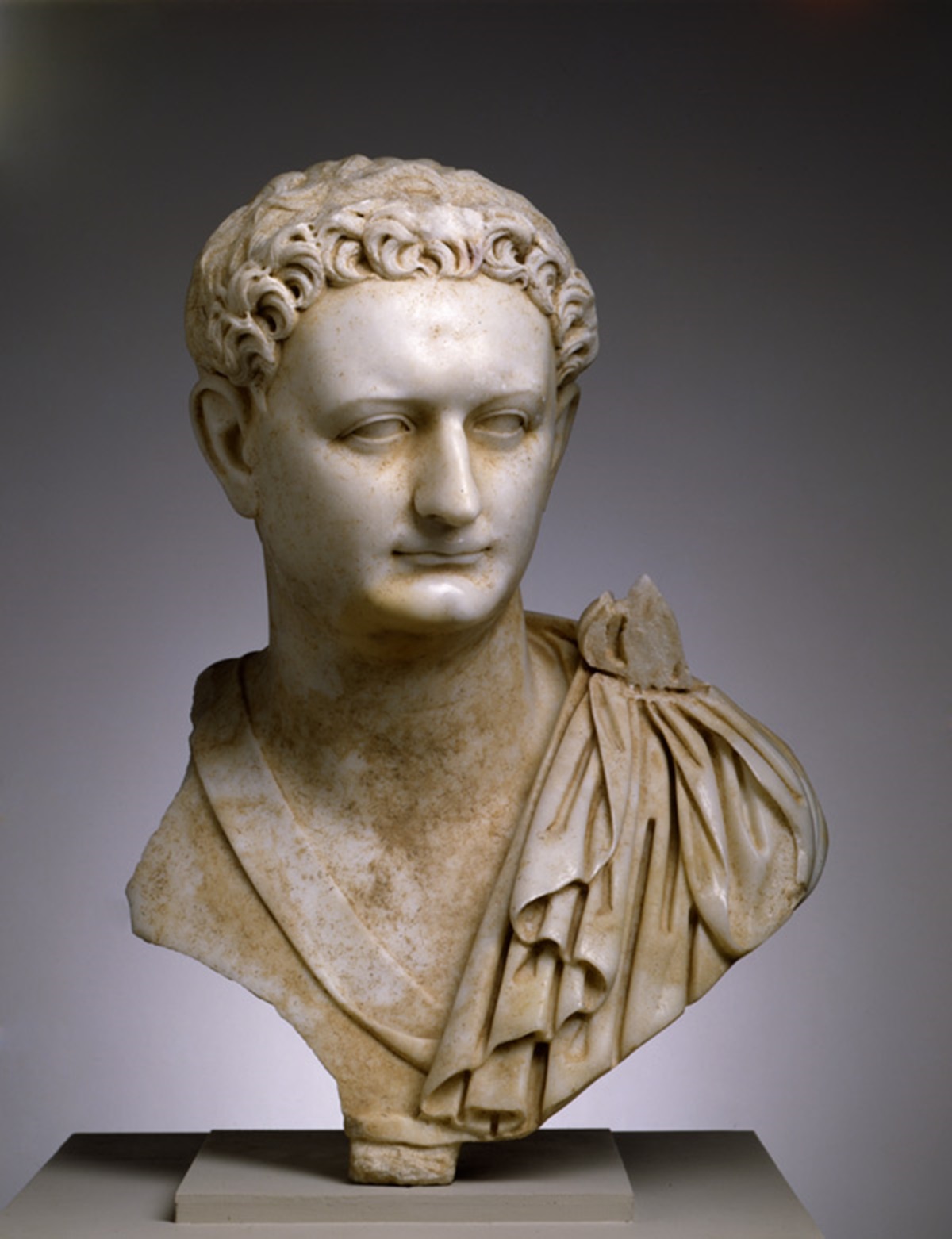
The first general persecution of Christians seems to have occurred during the reign of Domitian (81-96). (The so-called first persecution under Nero is spurious - see Appendix.)
In Suetonius we have,
Domitian's agents collected the tax on Jews [the Fiscus Judaicus] with a peculiar lack of mercy; and took proceedings not only against those who kept their Jewish origins a secret in order to avoid the tax, but against those who lived as Jews without professing Judaism.1
From Philip of Side, we have,
Domitian, the son of Vespasian, having demonstrated many wicked [qualities/acts] to the Romans who were governmental officials, was the second [sic] to conduct a persecution against the Christians.2
Church historian Orosius (c.375-c.418) declares,
For fifteen years this ruler progressed through every degree of wickedness. Finally he [Domitian] dared to issue edicts for a general and most cruel persecution to uproot the Christian Church, which was now very firmly established throughout the world.3
In Eusebius we read,
He [Domitian] was in fact the second [sic] that stirred up a persecution against us, although his father Vespasian had undertaken nothing prejudicial to us.4
The reason Vespasian (or Titus) did not persecute Christians may have been because the adherents were not numerous enough at that time (between 69 and 81) to attract imperial attention or they may have felt some sympathy for the plight of Jews and those with Jewish leanings in general. However, it is likely that there was initially local opposition, from Jews and pagans (Acts 17:1-9). Where only Jews were involved these matters may have been dismissed by Roman authorities as "questions about words and names and your own law." (Acts 18:15)
The Romans would only have intervened if there were threats to public order. Various incidents are recorded in Acts which may be based on actual events. By analogy the Book of Mormon was published in 1830 and local persecution of Mormons began almost immediately. The persecutors were "composed of various religious parties, but mostly Campbellites, Methodists and Baptists."5 These events did not escape the notice of the media, and the general populace. In the same fashion, we can rightly surmise that if Christians had existed between 30 and 70 the reaction of orthodox Jews to their presence would have been noted by Josephus, and other Jewish historians.
Paul records persecution which was probably local and not instituted by the emperor. "We are hard pressed on every side, but not crushed; perplexed, but not in despair; persecuted, but not abandoned; struck down, but not destroyed." (2 Corinthians 4:8-9) "In fact, when we were with you, we kept telling you that we would be persecuted. And it turned out that way, as you well know." (1 Thessalonians 3:4)
Later in his career, Paul is on trial in Rome. (2 Timothy 4:16, Philippians 1:12-14, 4:22) Everything points to this occurring under Domitian. When Domitian was murdered in 96 all records of his deeds were ordered to be destroyed by the Senate6 and this may explain why we do not have more information about persecution of Christians at this time.
Notes
1.Lives of the Twelve Caesars, Domitian in Graves & Grant, 2003, p.312.
2. Philip of Side Fragment 4.3
3. Historiae Adversus Paganos, Book 7.10. But see Jones, 1992, pp 114-7.
4. Ecclesiastical History, Book 3.17.
5. Church of Jesus Christ of Latter-day Saints & Roberts, 1902, Vol 1, p.265.
6. Suetonius, Domitian, 23.
_
This argument suggests that the lack of imperial persecution prior to the reign of Domitian (AD 81-96) indicates that Christianity was not a distinct or significant movement during the mid-first century. It posits that the "first" persecution under Nero (AD 64) is a later legend and that the actual emergence of Christianity as a visible, empire-wide entity occurred post-AD 70.
The strength of this argument lies in its historical silence. If a movement as "threatening" as Christianity had been flourishing in the AD 40s and 50s, we should expect more than just the vague, disputed mention of "Chrestus" in Suetonius. By shifting the "Pauline trials" and imperial scrutiny to the reign of Domitian, the argument aligns the movement's growth with its first clear appearance in the Roman tax records (Fiscus Judaicus). The comparison to the Mormon movement is an insightful sociological point: new religious movements usually trigger immediate, documented public reaction. If Christians were active in the 30s, the "silence" of Josephus and Roman officials is indeed a major anomaly.
The weakness is that Roman law often ignored "superstitions" until they caused riots. The absence of state-sponsored persecution does not prove a movement's non-existence; it may simply prove the movement was still viewed as a Jewish sub-sect (as Acts 18:15 suggests). Furthermore, the argument relies on the destruction of Domitian's records to explain the lack of detail, which is a "gap" argument that is difficult to prove or disprove.
If the orthodox thesis--that Christianity was a massive, persecuted force by the AD 60s--were correct, we should see:
• Secular Records of the Neronian Persecution: Outside of Tacitus (writing 50 years later), there are no contemporary Roman accounts of "Christians" being executed in AD 64.
• Josephus's Commentary on "Christian" Disturbances: Josephus is meticulous about Jewish messianic pretenders and "prophets" who caused trouble before the war. If Jesus's followers were active and causing "no little stir" (as Acts claims), his near-total silence on them is statistically improbable.
• Pre-70 Apologies: Early religious movements usually produce defensive literature during their first major conflict. We have no apologies addressed to Nero or Vespasian; the genre only appears in the 2nd century (Quadratus, Justin Martyr).
Concerning the Old Testament Book of Daniel, Schurer says, "The high estimation in which from the first this book was held by believing Israelites is best shown by the fact that it always continued to retain its place in the canon."1
Daniel was quoted and referenced by both Jews and Christians in the first century as predicting the imminent end-time.2 For our purposes the relevant passage in the context of a somewhat obscure prophecy is the following.
After the sixty-two weeks, an anointed one shall be cut off and shall have nothing, and the troops of the prince who is to come shall destroy the city and the sanctuary. (9:26)
The early Christian author, Tertullian (c.155--c.240) in arguing against the Jews for the coming of Christ as a past event says that the "leader" is destroyed at the same time as the city is destroyed. Everyone agreed that the city had been destroyed. He says,
Accordingly, the times must be inquired into of the predicted and future nativity of the Christ, and of His passion, and of the extermination of the city of Jerusalem, that is, its devastation. For Daniel says, that "both the holy city and the holy place are exterminated together with the coming Leader, and that the pinnacle is destroyed unto ruin."3
He also says in another place,
For the Scripture says thus, that 'the city and the holy place are simultaneously exterminated together with the leader,'--undoubtedly (that Leader) who was to proceed 'from Bethlehem,' and from the tribe of 'Judah.' Whence, again, it is manifest that 'the city must simultaneously be exterminated' at the time when its 'Leader' had to suffer in it, (as foretold) through the Scriptures of the prophets.4
Although Tertullian in a contradictory fashion goes on to argue for the orthodox chronology of the birth of the Christ it can be seen that an observer in the first century would quite naturally link the destruction of the sanctuary (that is, the Temple) with the death of the anointed one (that is, the Christ). There would have been no reason from the point of view of Daniel's prophecy to backdate the death of Jesus.
Notes
1. Schurer, 1972, p.53.
2. Quoted in Matthew as, "So when you see the desolating sacrilege standing in the holy place, as was spoken of by the prophet Daniel (let the reader understand)," (24:15)
3. Adversus Judaeos, 8.
4. Ibid., 13.
_
This argument utilizes the prophetic interpretation of Daniel 9:26 and the writings of Tertullian to suggest that the "Anointed One" (Christ) was historically linked to the immediate destruction of Jerusalem in AD 70, rather than a point forty years prior.
The strength of this argument is its focus on contemporary prophetic expectations. In the first century, the Book of Daniel was the primary lens through which Jews and Christians viewed the "End Times." Daniel 9:26 explicitly states that the city and sanctuary are destroyed together with (or "simultaneously with") the cutting off of the Anointed One. Tertullian, despite elsewhere defending the orthodox AD 30 date for the crucifixion, admits that the "Leader" and the "City" are "simultaneously exterminated." This implies a surviving tradition where Jesus was not a figure of the distant past (the 30s), but the central figure of the AD 70 cataclysm itself.
exterminated." This implies a surviving tradition where Jesus was not a figure of the distant past (the 30s), but the central figure of the AD 70 cataclysm itself.
The weakness is that Tertullian's primary goal was theological polemics, not historiography. Like many Church Fathers, he sought to prove to Jews that their Temple fell because they killed the Messiah. Using "simultaneously" might be a rhetorical device to emphasize the causal link (crime and punishment) rather than a chronological claim that the events happened in the same month or year.
If the orthodox thesis--that Jesus died in AD 30 and Daniel's prophecy was fulfilled forty years later--were correct, we should see:
• An Explanation for the 40-Year Gap: Early Christian writers should have been forced to explain why Daniel says "together with" when there was actually a four-decade delay. Instead, we see writers like Tertullian and Aphrahat glossing over the gap as if it didn't exist.
• Non-Christian "Anointed Ones": If the prophecy was so clearly about AD 70, we should see Jewish records of a specific messianic figure (a "Leader") who was "cut off" right as the walls fell. While we see rebel leaders like Simon bar Giora, the Christian tradition's insistence on their leader fitting this specific prophecy suggests a chronological overlap.
• Literal Prophetic Fulfillment: In a culture obsessed with the "letter of the Law" and prophecy, the "40-year generation" (the time between AD 30 and 70) should be the most famous number in the New Testament. Instead, the focus remains on the "simultaneity" of the destruction and the Christ-event.
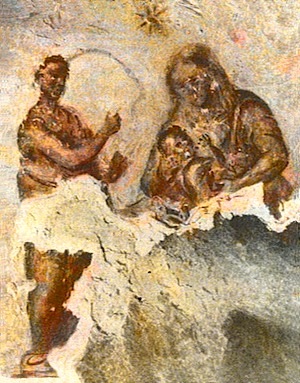
The sign of a star (actually Halley's comet) appeared in 66 CE. Its previous appearance had been in 12 BCE.1 Josephus says,
... they [the Jews in Jerusalem] did not attend nor give credit to the signs that were so evident, and did so plainly foretell their future desolation, ... Thus there was a star resembling a sword, which stood over the city, and a comet, that continued a whole year.2
Tacitus says that in Rome,
At the close of the year [64] people talked much about prodigies, presaging impending evils. Never were lightning flashes more frequent, and a comet too appeared, for which Nero always made propitiation with noble blood. Human and other births with two heads were exposed to public view, or were discovered in those sacrifices in which it is usual to immolate victims in a pregnant condition. And in the district of Placentia, close to the road, a calf was born with its head attached to its leg. Then followed an explanation of the diviners, that another head was preparing for the world, which however would be neither mighty nor hidden, as its growth had been checked in the womb, and it had been born by the wayside.3
An allusion to this portent has been written into Matthew's gospel as the heavenly sign, the star that the wise men from the east observed and interpreted as heralding the birth of the king of the Jews. (Matthew 2:2). That Jesus was "neither mighty nor hidden" and "born by the wayside" is also related in the second chapter of the gospel.
Ignatius of Antioch says specifically that Jesus was revealed as a star, which heralded the ruin of the ancient kingdom.
How then, was he [Jesus] revealed to the ages? A star, brighter than all other stars, shone in the heaven, and its brightness was ineffable and its novelty brought forth astonishment. But the rest of the stars, together with the sun and the moon, formed a choir around the star; but it exceedingly outshone them all with its light. Now it was perplexing to know the origin of this novelty which was unlike anything else. Thereupon all magic was dissolved, every bond of malice disappeared, ignorance was destroyed, the ancient kingdom was ruined, when God appeared in the form of a human to give us newness of an eternal life. (Letter to the Ephesians 19)
It would have seemed to those first century Jews primed to see it---if not immediately then retrospectively---that Old Testament prophecy had been fulfilled when the comet appeared. It was in their sacred writings. The divine seer Balaam4 is reported to have said, "I see him, but not now; I behold him, but not near---a star shall come out of Jacob, and a sceptre shall rise out of Israel." (Numbers 24:17)
Justin Martyr makes the connection in his Dialogue with Trypho the Jew.
And that He [Jesus] should arise like a star from the seed of Abraham, Moses showed beforehand when he thus said, 'A star shall arise from Jacob, and a leader from Israel;' and another Scripture says, 'Behold a man; the East is His name.' Accordingly, when a star rose in heaven at the time of His birth, as is recorded in the memoirs of His apostles, the Magi from Arabia, recognising the sign by this, came and worshipped Him. (106.4)
The star prophecy was also mentioned in the War Scroll (11) found at Qumran.
Notes
1. Cassius Dio, Roman History 54.29.8.
2. Wars of the Jews 6.288--289.
3. Annals, 15.47.
4. Puech, 2008, p.25ff.
_
This argument identifies a specific celestial event--the appearance of Halley's Comet in 66 CE--as the historical core of the "Star of Bethlehem" narrative. It suggests that the star was not a silent marker of a birth in 4 BCE, but a loud, terrifying omen of the Jewish War that was later reinterpreted by the Church as the "sign of the Son of Man."
The strength of this argument lies in the unanimity of contemporary witnesses. Both Josephus and Tacitus record celestial "prodigies" in the mid-60s CE. Specifically, Josephus describes a "star resembling a sword" that hung over Jerusalem for an entire year. Ignatius of Antioch (c. 35-107 CE) explicitly links this "ineffable" star to the ruin of the ancient kingdom (Judea). This creates a direct causal link: the star appeared, the kingdom fell, and "God appeared in human form" to replace it. From a revisionist perspective, the "Star of Jacob" from Numbers 24:17 was fulfilled by the comet of 66 CE, which announced the destruction of the old world and the birth of the new "Christian" age.
The weakness is the Traditionalist Astronomer's view. Many scholars attempt to find planetary conjunctions in 7-4 BCE to satisfy the Matthean timeline. However, these conjunctions were often subtle and only visible to astrologers. The comet of 66 CE, by contrast, was a "novelty" that brought "astonishment" to the entire Roman world, matching the dramatic description given by Ignatius.
If the orthodox thesis--that the star was a private sign for Magi in 4 BCE--were correct, we should see:
• Historical Mentions: A star significant enough to lead foreign dignitaries across deserts should have been recorded by the court astronomers of Rome or China. There is no major "new star" recorded in 4 BCE.
• A Peaceful Fulfillment: The "Star of Jacob" should have led to a restoration of the Davidic throne. Instead, the 66 CE star led to the total "ruin of the ancient kingdom," which is exactly what Ignatius says the star of Jesus achieved.
• Decoupling from "Impending Evils": Tacitus reports that the comet of the 60s CE presaged "another head preparing for the world." This matches the birth of a new "King" or "Head" (Jesus) appearing "by the wayside" (the manger/the poor).
Josephus says, "So it was when a star, resembling a sword, stood over the city, and a comet which continued for a year."1
Luke (2:34-35) links the sword metaphor with the sign of the child's coming into the world.
Then Simeon blessed them and said to his mother Mary, "This child is destined for the falling and the rising of many in Israel and to be a sign that will be opposed so that the inner thoughts of many will be revealed--and a sword will pierce your own soul, too."
The Old Testament prophet Ezekiel was instructed to warn Israel and Jerusalem of God's sword.
In chapter 21 we read,
The word of the Lord came to me: Mortal, set your face toward Jerusalem and preach against the sanctuaries; prophesy against the land of Israel and say to the land of Israel, Thus says the Lord: I am coming against you, and will draw my sword out of its sheath, and will cut off from you both righteous2 and wicked. (1-3)
A sword, a sword is sharpened, it is also polished; it is sharpened for slaughter, honed to flash like lightning! (9-10)
Remove the turban, take off the crown; things shall not remain as they are. Exalt that which is low, abase that which is high. A ruin, a ruin, a ruin--I will make it! (Such has never occurred.) Until he comes whose right it is; to him I will give it. (26-27)
Although this was probably written during the siege of Jerusalem by the Babylonians in the sixth century BCE it could have been interpreted by those who placed great store in the holy writings as applying to events then current in the first century. Note that the coming of the one whose right it was to govern is associated with the appearance of the sword over the city.
Notes
1. Wars of the Jews 6.288-9.
_
This argument identifies the "Sign of the Sword" as a shared motif between the historical record of the Roman destruction of Jerusalem and the theological birth narrative of Jesus. It suggests that the "sword" mentioned in the Gospel of Luke is not a generic metaphor for sorrow, but a specific reference to the celestial omen that Josephus says hung over Jerusalem during the Jewish War (66-70 CE).
The strength of this argument lies in the convergence of three sources:
1. History (Josephus): He records a literal "star resembling a sword" and a comet that appeared over Jerusalem as a precursor to its destruction.
2. Prophecy (Ezekiel 21): The "Sword of the Lord" is sharpened for slaughter and associated with a "ruin, a ruin, a ruin"---a state that lasts "until he comes whose right it is."
3. Theology (Luke 2): Simeon tells Mary that Jesus is a "sign that will be opposed" (like the omen) and that a "sword will pierce her soul, also..." linking the child's destiny to the falling and rising of many in Israel.
From a revisionist perspective, the "Sword" that Simeon predicts is the literal Roman sword that destroyed Mary's homeland and the "sword-star" that announced it. This allows the Gospel writer to frame the catastrophe of 70 CE as an event predicted at the very moment of Jesus's birth.
The weakness is that traditionalists interpret Mary's "sword" purely as a metaphor for the emotional agony she felt at the Crucifixion. They argue that the "Sword of Ezekiel" was fulfilled by the Babylonians and that any 1st-century parallels are merely archetypal. However, for a 1st-century reader, the "Sword over the City" was a terrifyingly recent historical fact.
If the orthodox thesis--that Simeon's prophecy was about the events of AD 33--were correct, we should see:
• A Non-Military Metaphor: The prophecy should likely focus on the cross or the rejection of the message. Instead, it uses the language of "falling and rising," which in the 1st century almost always referred to national/political upheaval and war.
• Separation of Omen and Child: If the "Sword" was purely spiritual, why did the early Church preserve this specific prophecy in a Gospel written (most scholars agree) in the aftermath of a war where a literal "Sword" was the primary omen?
• A "Ruin" in the 30s: Ezekiel says the sword brings "ruin" until the rightful ruler comes. In the 30s, Jerusalem was a thriving metropolis. In the 70s, it was a literal ruin.
The humiliation and defeat of the Jews appears to be a past event in Paul's writings.
In Paul's first letter to the believers in Thessalonica, he writes:
...the Jews . . . killed both the Lord Jesus and the prophets, and drove us out; they displease God and oppose everyone by hindering us from speaking to the Gentiles so that they may be saved. Thus they have constantly been filling up the measure of their sins; but God's wrath has overtaken them at last.1 (1 Thessalonians 2:14-16)
Paul's letter to the Romans also appears to have been written after the year 70. In this letter Paul says, regarding the Jews:
I ask, then, has God rejected [Greek: ἀπώσατο] his people? (11:1)
They [the Jews] were broken off [Greek: ἐξεκλάσθησαν] because of their unbelief. (11:20)
There will be anguish and distress for everyone who does evil, the Jew first and also the Greek. (2:9) [my emphasis]
How would Paul have known what the order of punishment was unless the first stage had already been determined?
Four years after the end of the Great War in 1918, Pope Pius XI issued his first encyclical Ubi Arcano Dei Consilio. In this work of about 11,500 words the Great War is mentioned 14 times. Nine years later the same term gets only one mention in his much longer *Quadragesimo Anno*. Both encyclicals deal with similar themes. Using the writings of the Pope as a guide and noting the indirect references to the War in Paul, we can reasonably speculate that he starting writing about 10 years after the event.
Another near contemporary ancient, Pliny the Younger was seventeen years old when Mount Vesuvius erupted in 79 CE, an incident that killed his uncle and would have been deeply traumatic. However, he only wrote about the event in two letters to the historian Tacitus, approximately 25 years later and only in response to Tacitus' specific request. In his extensive correspondence covering daily life, politics and personal matters, it is noteworthy that Pliny neglects to mention this formative experience. It should not be surprising therefore to find that Paul in respect of his own trauma is equally silent.
Notes
1. "The interpretation suggested by Baur and others is still valid: I Thessalonians 2:16c refers to the destruction of Jerusalem in 70 A.D." Pearson, 1971, p.83.
_
This argument utilizes the internal language of the Pauline Epistles to suggest that the Apostle Paul was writing in the wake of the Roman destruction of Judea, rather than in the mid-50s CE.
The strength of this argument lies in the past-tense finality of the language used in 1 Thessalonians 2:16. The phrase "God's wrath has overtaken them at last" (or eis telos---to the end/utterly) is notoriously difficult for orthodox scholars to explain as a pre-70 statement. It strongly mirrors the "theology of punishment" found in post-war literature, where the Temple's fall is seen as the final judgment on the Jews for rejecting Jesus. Similarly, the "broken off" imagery in Romans 11 suggests a post-catastrophe reflection on the Jewish nation's status. The comparison to Pliny the Younger and Pope Pius XI provides a sophisticated sociological framework: it explains Paul's "silence" on the war not as ignorance, but as the natural processing of trauma and the fading frequency of a monumental event in discourse.
The weakness is the possibility of interpolation. Many critical scholars who hold to the orthodox dating of Paul argue that 1 Thessalonians 2:14-16 was a later addition by a post-70 scribe to align Paul with the fall of Jerusalem. Furthermore, "God's wrath" could refer to earlier events, such as the expulsion of Jews from Rome under Claudius (AD 49) or a contemporary famine, rather than the total destruction of the city.
If the orthodox thesis--that Paul wrote in the 50s and died in the 60s--were correct, we should see:
• A Present-Tense Temple: Paul should refer to the Temple and its sacrifices as a functioning, daily reality that poses a current theological competition. While he uses cultic imagery, he never addresses the logistical reality of the Temple's continued existence in a way that anchors him clearly in the 50s.
• Lack of "Judgment" Language: 1 Thessalonians should focus on future judgment rather than stating that wrath "has overtaken them." In prophetic literature, "has overtaken" usually follows a visible, historical disaster.
• Earlier Secular Confirmation: If Paul were a pre-70 figure, his letters---which claim to have reached "all the churches of the Gentiles"---should have left some footprint in the secular or archaeological records of the mid-1st century. Instead, the first non-Christian mentions of these communities cluster in the early 2nd century.
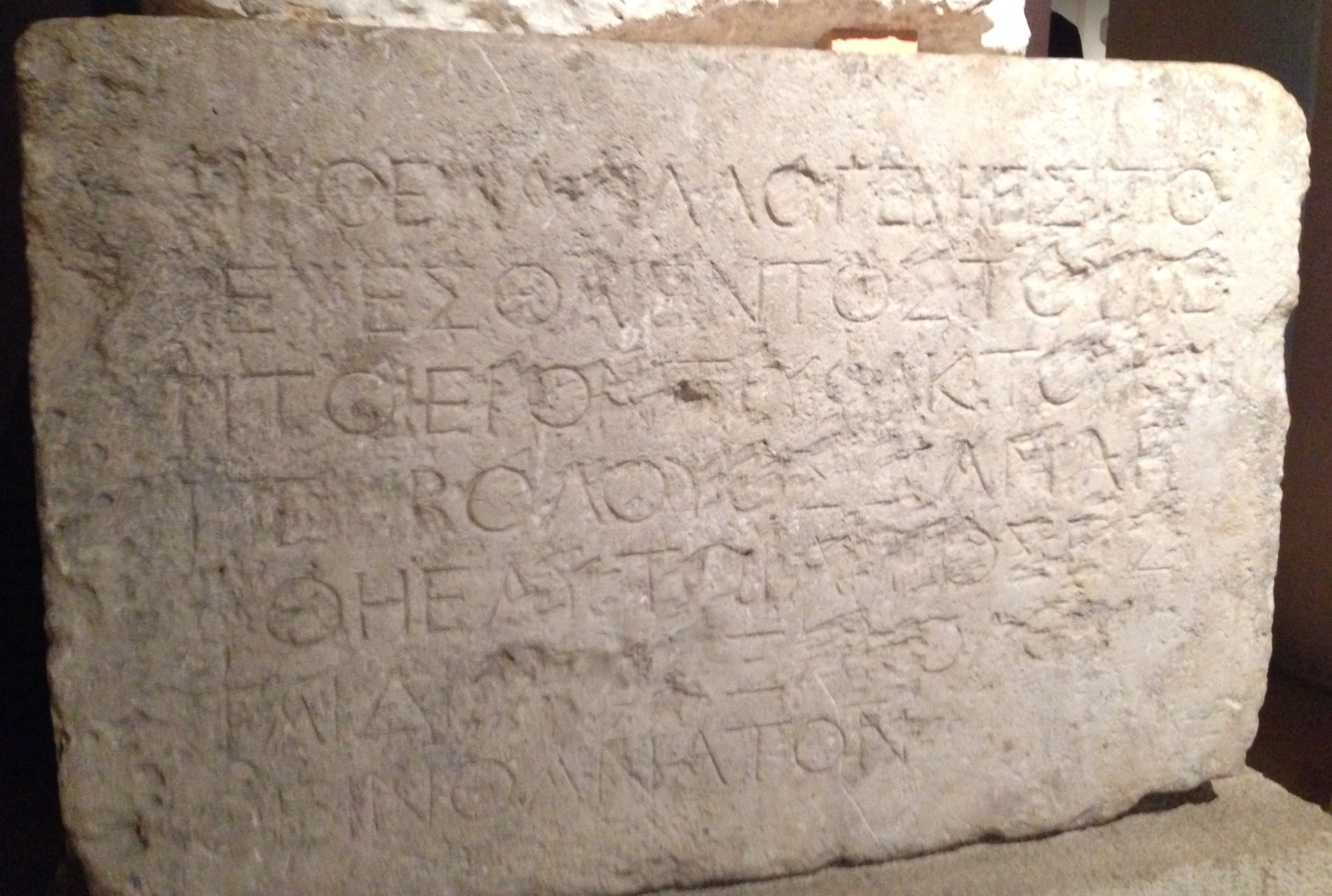
Many New Testament scholars conclude that the letter to the Ephesians was written after 70CE, because it refers to the destruction of the dividing wall between the Court of the Gentiles and the Court of Israel in the Jerusalem Temple.1 This letter was recognised by the early church as authored by Paul.2 Irenaeus c.170 declares it is the work of Paul.3 Eusebius writing about 320 CE declared that all of Paul's fourteen epistles were well known and undisputed.4 According to Josephus5 a five-foot wall separated the Outer Court of the Gentiles from a set of stairs that led to the sanctuary, the platform on which the Temple stood. Gentiles were warned by Greek and Latin inscriptions fixed on pillars not to proceed beyond that point.6 The Romans had given permission to the Jews to execute any who transgressed the prohibition.7
The warning tablet found in Jerusalem bears the following inscription in Koine Greek:
ΜΗΘΕΝΑ ΑΛΛΟΓΕΝΗ ΕΙΣΠΟΡΕΥΕΣΘΑΙ ΕΝΤΟΣ ΤΟΥ ΠΕΡΙ
ΤΟ ΙΕΡΟΝ ΤΡΥΦΑΚΤΟΥ ΚΑΙ ΠΕΡΙΒΟΛΟΥ ΟΣ Δ ΑΝ ΛΗΦΘΗ
ΕΑΥΤΩΙ ΑΙΤΙΟΣ ΕΣΤΑΙ ΔΙΑ ΤΟ ΕΞΑΚΟΛΟΥΘΕΙΝ ΘΑΝΑΤΟΝ
"No foreigner is to enter within the barrier around the temple and the enclosure. Whoever is caught will be responsible himself for the death that follows."
In Ephesians we read,
For he [Christ Jesus] is our peace; in his flesh he has made both groups [Jews and Gentiles] into one and has broken down the dividing wall, that is, the hostility between us. (2:14)
Barth notes that, "the (aorist) tense 'he has broken down' reveals that Paul wants to speak of the factual, historical, completed destruction of the obstacle."8
The context of the passage is reconciliation of Jews and Gentiles and the constitution of a new temple. (v. 19-20) The author of Ephesians is clearly alluding to the wall which was broken down when the Romans destroyed the Temple at the conclusion of hostilities. Paul tells the believers that they now constitute a NEW temple, a new dwelling place for God. The passage could have been written before 70 CE but the context better suits a late date.
Notes
1. Kitchen, 2002, p.65. Also "It has further been argued that the readers of Ephesians could understand the unique image of the broken wall in Eph 2:14 only if it is an allusion to the destruction of Jerusalem in A.D. 70." Barth, 1974, p.12.
2. Muratorian fragment dated c.170.
3. Against Heresies, Book 5.
4. Ecclesiastical History, Book 3.3.
5. Wars of the Jews 5.193-194.
6. Philo, Embassy to Gaius, 31.
7. "Have not you [Jews] been allowed to put up . . . at due distances, and on it to engrave in Greek, and in your own letters, this prohibition, that no foreigner should go beyond that wall. Have not we given you leave to kill such as go beyond it, though he were a Roman?" Wars of the Jews 6.124-126.
8. Barth, 1974, p.263.
_
This argument utilizes the specific imagery of the "dividing wall" in Ephesians 2:14 to suggest that the letter--and by extension its author, Paul--must date to the post-AD 70 period.
The strength of this argument lies in its historical and archaeological specificity. The Soreg (the stone balustrade) was a physical reality in the Jerusalem Temple that strictly separated Jews from Gentiles, under penalty of death. Josephus and archaeological finds (like the Warning Tablet) confirm its existence. For the author of Ephesians to state that Christ has "broken down" this wall in the past tense (aorist) strongly implies a post-70 perspective. While a pre-70 Paul might speak of "spiritual" barriers being removed, the physical destruction of the Temple by the Romans provided a "factual, historical" realization of this theology that would be immediately recognizable to a late-first-century audience.
The weakness is the question of authorship. Many modern scholars agree that Ephesians is "deutero-Pauline" (written by a disciple after Paul's death). However, the argument notes that the early church (Irenaeus, Eusebius) was unanimous in attributing it to Paul himself. If we accept the early church's witness that Paul wrote it, and we accept the archaeological allusion to the Temple's fall, we are forced to move Paul's entire career into the post-70 era.
If the orthodox thesis--that Paul wrote Ephesians in the early 60s while the Temple was still standing--were correct, we should see:
• Present-Tense Warnings: Paul should warn Gentile converts not to cross the physical wall in Jerusalem to avoid execution (as he was accused of doing with Trophimus in Acts 21:28). Instead, he speaks of the wall as a defunct obstacle of the past.
• Literal vs. Metaphorical Clarity: If the wall were still standing, Paul's metaphor would be dangerously misleading, potentially encouraging Gentiles to risk their lives. If the wall were already rubble, the metaphor becomes a powerful theological reflection on a visible historical event.
• A Future-Tense "New Temple": In a pre-70 context, the "New Temple" (the Church) would be a rival to the existing one. In a post-70 context, the New Temple is the successor to the destroyed one, which fits the rhetorical flow of Ephesians 2:19-22 much more naturally.
Paul never mentions a forerunner to Jesus; he never mentions John the Baptiser, although he must have heard of him. John the Baptiser seems to have had no theological significance for Paul. This is odd because John the Baptiser is a central character in the Gospel narratives, and the baptism of John is also mentioned in the book of Acts. We can explain the lack of interest by Paul by noting that John the Baptiser died about 36 CE1 and the rumour of Jesus appearance, in line with our argument, began about 70 CE. Hence there would have been no reason for Paul and the earliest Christians to connect John to Jesus.
However, we read in the gospels that the disciples of John fasted while the followers of Jesus did not2, so it may be true that John's teaching or a variation of it survived into the 90's. Disputation about the status of John can be found in the gospels. See John 5:36. The ancient sect of the Mandaeans honoured John and rejected Jesus as the Messiah.3
We submit that Matthew, the writer of the first gospel, was responsible for connecting the two lives as the contrived fulfilment of some passages from the prophets--or perhaps Matthew was reporting what had become a common belief. Either way it served a theological purpose to have John meet Jesus so that the superiority of Jesus could be demonstrated. The existence of John in history also served as an anchor for stories about Jesus.
Notes
1. Antiquities of the Jews, Book 18.109--119.
2. Mark 2:18, Matthew 9:14.
3. Buckley, 2002..
4. Matthew 3:1-3 from Isaiah 40:3.
_
This argument highlights the silence of Paul regarding John the Baptist to suggest that the two figures belonged to entirely different eras, and that their "connection" was a late literary invention by the Gospel writers to ground the Jesus story in history.
The strength of this argument lies in the total absence of John the Baptist from the Pauline epistles. If Paul was writing in the 50s CE and John was the famous "forerunner" who baptized Jesus only 20 years prior, it is historically remarkable that Paul never uses John as a witness, a theological foil, or a point of reference. By placing John's death in the mid-30s (as per Josephus) and the start of the "Jesus rumor" around AD 70, the argument provides a clean explanation for this silence: for the earliest Christians, the two men were simply unrelated. The connection only became necessary later to subordinate John's surviving sect (the Mandaeans) to Christianity.
The weakness is that Paul's letters are "occasional"---they address specific congregational problems, not a complete biography of Jesus. Paul also fails to mention Jesus's parables, his miracles, or the Virgin Birth, yet scholars don't usually conclude Paul hadn't heard of them. Additionally, Acts 19:1--7 explicitly depicts Paul encountering disciples of John in Ephesus, which contradicts the idea that Paul was unaware of him, though revisionists often view Acts as a late first century attempt to harmonize these disparate traditions.
If the orthodox thesis--that John the Baptist was the widely recognized herald of Jesus in AD 30--were correct, we should see:
• Apostolic Citation: Paul should appeal to the authority of John the Baptist when defending Jesus's messiahship to Jewish audiences. Instead, Paul relies exclusively on Old Testament scripture and personal revelation.
• Unified Sects: If John explicitly pointed to Jesus, his followers should have logically merged into the Christian movement immediately. Instead, history shows the Mandaeans and other "Baptist" groups remaining distinct and even hostile to the Christian claim.
• Contemporary Synchronization: Secular writers like Josephus, who writes extensively about John the Baptist, should mention his link to a famous "Jesus" if that link were common knowledge in the first century. Instead, Josephus discusses them in completely separate contexts.
The witness of James as recorded in Acts, appears to make the mission to the Gentiles contingent on the rebuilding of Jerusalem.
After they finished speaking, James replied, "My brothers, listen to me. Simeon has related how God first looked favourably on the Gentiles, to take from among them a people for his name. This agrees with the words of the prophets, as it is written, 'After this I [the Messiah] will return, and I will rebuild the dwelling of David, which has fallen; from its ruins I will rebuild it, and I will set it up, so that all other peoples may seek the Lord--even all the Gentiles over whom my name has been called. Thus says the Lord, who has been making these things known from long ago.'" (15:13-18)
The rebuilding of the city of David (that is Jerusalem) can only occur after its destruction. It was destroyed in the year 70, hence the Gentiles were called after 70 CE.
_
This argument focuses on the Apostolic Decree in Acts 15, highlighting a specific prophetic citation by James that logically requires the destruction of Jerusalem to have already occurred.
The strength of this argument is its logical sequencing. James quotes Amos 9:11-12, which speaks of rebuilding the "dwelling [tabernacle] of David" which has fallen and is in ruins. In the context of first-century Judea, the "dwelling of David" was synonymous with Jerusalem and its sacred institutions. If the mission to the Gentiles is scripturally justified by the need to rebuild these ruins, the ruins must exist. Since the city was not in ruins in AD 50 (the traditional date of the Council of Jerusalem), but was a smoking ruin after AD 70, the speech--and the Gentile mission it authorizes--fits a post-70 historical setting much more naturally.
The weakness is the metaphorical interpretation of "the dwelling of David." Orthodox scholars argue that James was referring to the dynasty or the spiritual lineage of David, which had "fallen" into obscurity under Roman rule, rather than the physical buildings of Jerusalem. In this view, the "rebuilding" is the resurrection of Jesus and the establishment of the Church, not a construction project following the Jewish War.
If the orthodox thesis--that this speech was delivered in AD 50--were correct, we should see:
• A Different Prophetic Choice: James would likely have quoted a prophecy about the "Light to the Nations" (like Isaiah 49:6) which does not depend on themes of "ruin" and "rebuilding". Choosing a "ruins" prophecy while the Temple stood in its greatest architectural glory would have been confusing to his audience.
• Clarification in the Text: The author of Acts should provide a note explaining that "ruins" refers to the spiritual state of Israel. Instead, the text leaves the quote as a literal justification for the inclusion of Gentiles.
• Contemporary Jewish Usage: We should see other mid-first-century Jewish groups using Amos 9 to describe their current situation. Instead, "rebuilding the ruins" becomes a dominant theme in Jewish and Christian literature specifically after the catastrophe of AD 70.
Berenice co-ruled with Agrippa II, often appearing in public and inscriptions as "queen" (basilissa) or "ruler." She was involved in diplomacy and showed piety: Josephus notes she took a Nazarite vow (a Jewish ascetic practice) and shaved her head in fulfillment. Her first marriage (around age 13-15) was to Marcus Julius Alexander (nephew of Philo of Alexandria), but it was short-lived as he died soon after. After her father's death in 44 CE, she married her uncle Herod of Chalcis (her father's brother), with whom she had two sons (Berenicianus and Hyrcanus). He died in 48 CE.
A dramatic moment came in 66 CE during the early stages of the First Jewish--Roman War. Under the corrupt procurator Gessius Florus, Roman troops massacred Jews in Jerusalem. Berenice, barefoot and dishevelled (in mourning or Nazarite mode), repeatedly begged Florus from his tribunal to stop the slaughter, sending messengers and risking her own life---she nearly faced assault by soldiers and had to flee to safety. Florus ignored her, and the violence escalated, helping spark the full revolt.1
A parable which appears in the gospel of Luke contains many clues that show that it was most likely based on these events.
He [Jesus] said, "In a certain city there was a judge who neither feared God nor had respect for people. In that city there was a widow who kept coming to him and saying, 'Grant me justice against my opponent.' For a while he refused; but later he said to himself, 'Though I have no fear of God and no respect for anyone, yet because this widow keeps bothering me, I will grant her justice, so that she may not wear me out by continually coming.'" And the Lord said, "Listen to what the unjust judge says. And will not God grant justice to his chosen ones who cry to him day and night? Will he delay long in helping them? I tell you, he will quickly grant justice to them. And yet, when the Son of Man comes, will he find faith on earth?" (Luke 18:2-8)
• The city is Jerusalem
• The unjust judge is the procurator, Gessius Florus (64-66) who was renowned for being thoroughly unscrupulous, corrupt and impious.
• The widow is Berenice, widow of Alexander (44 CE) and widow of Herod of Chalcis (48 CE), who tried by constant efforts to relieve the plight of the Jews.
• The chosen ones are the Jews, suffering injustice and oppression from the Romans under Florus.
• But they received no political justice, no political help from God.
The Son of Man, Jesus, did come, but as the unexpected suffering servant--hence he was unrecognized. When he came as the parable says, he found no faith on the earth.
Notes
1. Wars of the Jews 2.271ff.
_
This argument connects the Parable of the Unjust Judge to the historical encounter between Queen Berenice and the procurator Gessius Florus in AD 66. It suggests that the "parables of Jesus" are actually allegorical reflections on the specific political disasters that led to the Jewish War.
The strength of this argument lies in the striking historical parallels. Gessius Florus (procurator from AD 64-66) was described by Josephus in terms almost identical to the judge in the parable: a man who "neither feared God nor had respect for people." Furthermore, Berenice was a twice-widowed queen who famously stood before Florus's tribunal in a state of mourning (barefoot and dishevelled) to plead for justice for her people during the Jerusalem massacre. If the parable is a "thinly veiled" commentary on these events, it places the composition of the Gospel of Luke firmly in the post-AD 70 era, looking back at the failed pleas for mercy that preceded the total destruction of the city.
The weakness is that the parable in Luke ends with the judge eventually granting justice, whereas the historical Gessius Florus refused Berenice and escalated the violence. To reconcile this, the argument must posit that the parable is an "inversion" or a theological promise--suggesting that while the earthly judge (Florus) failed the widow (Berenice), the Heavenly Judge will not fail His "chosen ones."
If the orthodox thesis--that Jesus told this parable in AD 30 to a Galilean audience--were correct, we should see:
• Generic Contextual Details: The parable should use standard ancient tropes about widows and judges that apply to any era. Instead, the specific pairing of a "shameless judge" and a "widow of high persistence" matches the unique political drama of AD 66 with startling accuracy.
• Earlier Attestation of the Parable: We should find this specific parable in the earliest layers of tradition (like the hypothetical Q source or the Gospel of Mark). Instead, it appears only in Luke, the Gospel most frequently cited by scholars as having a sophisticated, post-70 "historical" perspective.
• A Lack of Connection to "The Son of Man": The parable's conclusion (v. 8) ties the "justice" to the "coming of the Son of Man." In a pre-70 context, this is a vague prophecy. In a post-70 context, it is a direct commentary on why the "divine justice" (the destruction of the Temple) was not recognized as the arrival of the Son of Man.
Matthew reports on Jesus' triumphal entry into Jerusalem at the climax of his mission.
A very large crowd spread their cloaks on the road, while others cut branches from the trees and spread them on the road. The crowds that went ahead of him and those that followed shouted,
Hosanna to the Son of David!
Blessed is he who comes in the name of the Lord!1
Hosanna in the highest heaven! ...
Do you hear what these children are saying? they asked him.
Yes, replied Jesus, have you never read, From the lips of children and infants you, Lord, have called forth your praise2? (21:8-9,16)
What does Hosanna mean? Hosanna [Greek: Ὡσαννὰ transliterated from the Hebrew] comes from the Hebrew phrase הוֹשִׁיעָה נָּא (hôšîʿâ-nāʾ), or the shortened form הוֹשַׁע נָּא (hôšaʿ-nāʾ). It literally means: "Save (us), please!" or "Save now!" or "Please deliver us!"3
Hosanna in the highest! [Greek: Ὡσαννὰ ἐν τοῖς ὑψίστοις]
As it stands this phrase makes little sense. Why would the Jews in Jerusalem be crying out for help "in the highest?" There are no connecting words in the phrase such as "you who are", which would make the sentence meaningful.
A solution presents itself if we assume that the acclamation was originally made in Hebrew. Then translating back into that language from the Greek, we get bammerômîm from מָרוֹם (mārôm) meaning "height" or "elevation." ( בַּ ba- is the standard preposition meaning "in or at.") But the phrase still lacks an object.
Was the original expression "Save us from the Romans"?
The Hebrew for this is Hoshi'einu min ha‑Romā'im [הוֹשִׁיעֵנוּ מִן הָרוֹמָאִים] This phrase is remarkably similar to our reconstruction and could have been corrupted in translation or the Hebrew spoken by the crowd could have been based on the ancient psalms and used with a double meaning so as to not offend the Romans. The Psalms referenced by the evangelist are situated in a context where military victory is being pursued.
Between 66 and 70 CE the Romans prosecuted their campaign first in Galilee and then in Judea, and finally in the siege of Jerusalem. This urgent appeal to God to be saved from the Romans makes sense if we fit the phrase to the context of the siege of Jerusalem.
Notes
1.Psalm 118:25,26 Lord, save us! Lord, grant us success! Blessed is he who comes in the name of the Lord. From the house of the Lord we bless you [plural].
2. Psalm 8:2 Through the praise of children and infants you have established a stronghold against your enemies to silence the foe and the avenger.
3. Ziffer notes that, "It is used to this day in the synagogue in the special collection of Psalms found in all Jewish prayer books under the title of 'Hallel!' that consists of Psalms 113-118. These psalms are chanted on certain festival days." (2006, p.102)
_
This argument proposes that the "Triumphal Entry" into Jerusalem--specifically the cry of "Hosanna"--is a linguistic and historical fossil of the Siege of Jerusalem (AD 70), rather than a peaceful procession in AD 30.
The strength of this argument lies in its philological reconstruction. The Greek phrase Hosanna en tois hypsistois ("Hosanna in the highest") is notoriously awkward and has no clear precedent in Jewish liturgy. However, as the argument notes, the Hebrew for "Save us from the Romans" (Hoshi'einu min ha‑Romā'im) sounds phonetically similar to the Greek transliteration and the reconstructed Hebrew for "in the heights" (bammerômîm). If the original cry was a desperate prayer for military deliverance during the Roman siege, it transforms Jesus's entry into an allegory of the city's final days. Furthermore, the use of Psalm 8:2 regarding "silencing the foe and the avenger" fits a military siege far better than a religious festival.
The weakness is that "Hosanna" was already a standardized liturgical shout derived from Psalm 118, used during the Feast of Tabernacles. While "in the highest" is unusual, it likely reflects a Hellenistic Jewish desire to direct the prayer to God's heavenly throne. To accept this argument, one must assume a massive "translation error" or a deliberate "coding" of the text by the author of Matthew to hide its original revolutionary meaning.
If the orthodox thesis--that Jesus entered Jerusalem in AD 30 to a peaceful, religiously motivated crowd--were correct, we should see:
• Roman Indifference: If the crowd was merely shouting religious slogans from the Psalms, the Roman garrison in the Fortress Antonia should have ignored it. Instead, the Gospels describe the "whole city being stirred" (Matthew 21:10), a reaction more consistent with a political or military uprising.
• A Lack of Military Language: The citations used by the Gospel writers (Psalms 8 and 118) should be purely devotional. Instead, both Psalms are situated in contexts of crushing national enemies and "establishing strongholds" against foes.
• Clearer Liturgical Continuity: The phrase "in the highest" should appear in other Jewish literature from the period if it was a standard religious greeting. Instead, it appears almost exclusively in the Christian "Triumphal Entry" narrative, suggesting it may be a corruption of a different, more urgent phrase.
We are told in the gospel of Luke that Jesus raised from the dead a young man who had lived in a town called Nain.
Soon afterwards he [Jesus] went to a town called Nain, and his disciples and a large crowd went with him. As he approached the gate of the town, a man who had died was being carried out. He was his mother's only son, and she was a widow; and with her was a large crowd from the town. (7:11-12)1
Josephus describes Nain (Greek: Ναΐν; Hebrew: Nein) as a village in lower Galilee, which appears to agree with archaeological surveys. Conder and others who visited the site in 1882-8 say that "there are numerous traces of ruins extending beyond the boundary of the modern hamlet to the north, showing the place to have been once larger . . . There is a small spring north of the village; a second, 'Ain el Baz, exists on the west, and beside it are rock-cut tombs, much defaced, and a tree."2
Prior to the Jewish War it appears that the town had no wall as Josephus says that the infamous leader of the revolt, Simon bar Giora "built a wall at a certain village called Nain, "built a wall at a certain village called Nain," using it as a fortress during the revolt.3 Luke says that Jesus and his party approached the gate of the town.4 Clearly there could only have been a gate if there had been a wall. Hence the story appears to be set in a time after June 68 when, with Nero dead and the Roman campaign temporarily halted due to the confused state of affairs in Rome, the rebel leader Simon bar Giora set up a wall around the town and used it as a fortress. Furthermore the apocryphal Gospel of Barnabas connects the Roman occupation with this miracle. Barnabas says, "At that time the army of the Romans was in Judea, our country being subject to them for the sins of our forefathers." (48.1)
Notes
1. This story bears many similarities to a story related by Apuleius; the saving of a man in a funeral procession, dressed ready for the funeral pyre and snatched from the jaws of death by the skill of the physician Asclepiades. (Florida 19)
2. Conder et al, 1998, p.86.
3. Wars of the Jews 4.503.
4. Cities were surrounded by walls, to defend them from their enemies. They were entered through "gates" placed at convenient distances from each other. In most cities it was not allowed to bury the dead within the walls; hence, they were carried to some convenient burial-place in the vicinity of the city. Barnes' Notes on the Bible, accessed at [Luke 7 Barnes' Notes](https://biblehub.com/commentaries/barnes/luke/7.htm)
_
This argument provides a striking "archaeological anachronism" that challenges the traditional setting of Jesus's ministry. It suggests that the Gospel of Luke inadvertently describes a version of the town of Nain that only existed after the outbreak of the Jewish War (66-70 CE), specifically under the command of the rebel leader Simon bar Giora.
The strength of this argument lies in its reliance on military architecture. Luke 7:11-12 explicitly mentions the "gate of the town." In 1st-century Judea, a gate implies a defensive wall. According to Josephus (who was the military governor of Galilee at the start of the war), Nain was a mere village--typically unpaved and unwalled. Josephus records that it was Simon bar Giora who "built a wall at a certain village called Nain" to convert it into a fortress around 68 CE. If Jesus approached a "gate" in Nain, he was walking into a fortification that did not exist in the 30s CE, but was a prominent landmark of the late 60s. This suggests the author of Luke was using the post-war landscape as the backdrop for his narrative.
The weakness is that "gate" (pylē) can sometimes be used loosely to describe the entrance to a town or a gap between buildings. However, Luke's description of a funeral procession exiting the gate to a burial place (consistent with the rock-cut tombs found by Conder) strongly implies a formal, walled boundary. Traditionalists might argue there was an earlier wall Josephus failed to mention, but Josephus is usually meticulous about Jewish fortifications.
If the orthodox thesis--that the miracle at Nain happened in the 30s CE--were correct, we should see:
• A Pre-War Wall: Archaeological evidence should show a fortification layer from the Herodian era. Instead, surveys show Nain was a small hamlet that only expanded into a fortified position during the revolt.
• Josephus Mentioning "Restoration": When Josephus describes Simon bar Giora at Nain, he says Simon built the wall (oteichisen), not that he repaired or strengthened an existing one.
• A Narrative without "Gates": The Gospel should describe Jesus meeting the procession on the "road" or "at the entrance" of the village. The specific mention of a pylē suggests the author was familiar with the fortified Nain of the war years.
According to Josephus, Zechariah, the son of Baruch was murdered by Zealots in a show trial in the Temple court in the year 69.1 Jesus appears to refer to the same incident at Matthew 23:34-36.
Therefore I [Jesus] send you prophets, sages, and scribes, some of whom you will kill and crucify, and some you will flog in your synagogues and pursue from town to town, so that upon you may come all the righteous blood shed on earth, from the blood of righteous Abel to the blood of Zechariah son of Barachiah, whom you murdered between the sanctuary and the altar. Truly I tell you, all this will come upon this generation.
Notes
1. Wars of the Jews 4.334-344.
_
This argument identifies a specific historical event--the murder of Zechariah, son of Baruch, in AD 69--as the definitive chronological anchor for the Gospel of Matthew, suggesting the "Jesus" character is speaking from a post-AD 70 perspective.
The strength of this argument is its historical precision. Josephus records that during the civil strife in Jerusalem (c. AD 68-69), a prominent and "righteous" man named Zechariah, son of Baruch (or Baris), was brought before a mock trial by the Zealots and subsequently slain "in the middle of the Temple." In Matthew 23, Jesus explicitly names "Zechariah son of Barachiah" as the final victim in a line of righteous blood. If Jesus is referencing a murder that occurred in AD 69, he could not be speaking in AD 30. This makes the statement an "anachronism" that exposes the text as a post-war composition.
The weakness lies in a potential identity confusion. Traditional scholars argue Jesus was referring to the Old Testament figure Zechariah, son of Jehoiada, who was stoned in the Temple court (2 Chronicles 24). However, that Zechariah's father was Jehoiada, not Barachiah. Others suggest he meant the prophet Zechariah (son of Berechiah), but there is no biblical record of that prophet being murdered in the Temple. The match with Josephus's Zechariah (AD 69) is the only one that fits both the location (between the sanctuary and altar) and the father's name (Baris/Baruch), but it requires acknowledging that the Gospel writer attributed the memory of a recent war crime to Jesus.
If the orthodox thesis--that Jesus spoke these words in AD 30--were correct, we should see:
• A Clear Old Testament Reference: Jesus should have named a victim whose death was well-known from the Hebrew Scriptures to emphasize his point to his contemporaries. Instead, the name he provides creates a "chronological knot" that only resolves when looking at the events of AD 69.
• Correction by Early Scribes: If this were a simple mistake by Matthew, we might expect early manuscript variants to "fix" the father's name to Jehoiada to match 2 Chronicles. While some later manuscripts do omit "son of Barachiah," the earliest and most reliable ones retain the name that links the event to the Jewish War.
• Separation of the "Generation": Jesus says these crimes will come upon "this generation." If he spoke in AD 30, the "generation" that killed a man in AD 69 is indeed the one that saw the Temple fall in AD 70. However, the use of the past tense ("whom you murdered") implies the act had already occurred when the words were written.
Jesus preaches,
Do you think that I have come to bring peace to the earth? No, I tell you, but rather division! From now on five in one household will be divided, three against two and two against three; they will be divided: father against son and son against father, mother against daughter and daughter against mother, mother-in-law against her daughter-in-law and daughter-in-law against mother-in-law." (Luke 12:51--53)
Jesus says "From now on..." indicating that this generational division would come into effect immediately. However, when we search the gospels and Acts we do not find this. We do find division but it is never along the lines described in the prophecy. (Luke 12:13, John 10:19, Acts 14:4, Acts 23:7)
However, Josephus records demographic strife and division within families in Jerusalem about the year 68--as described by Jesus.
There was also a bitter contest between those that were fond of war, and those that were desirous for peace. At the first this quarrelsome temper caught hold of private families, who could not agree among themselves; after which those people that were the dearest to one another brake through all restraints with regard to each other, and everyone associated with those of his own opinion, and began already to stand in opposition one to another; so that seditions arose everywhere, while those that were for innovations, and were desirous of war, by their youth and boldness, were too hard for the aged and prudent men.1 [italics added]
Jesus' saying accurately describes the demographic strife (young versus old) that attended the period of turmoil in Jerusalem about the year 68.
Notes
1. Wars of the Jews 4.128.
_
This argument connects the specific prophecy of familial and generational division found in Luke 12 to the documented civil strife in Jerusalem around AD 68, suggesting the "sayings of Jesus" are actually post-war reflections on the internal collapse of Judean society.
The strength of this argument lies in its sociological specificity. While general religious conflict is common, Jesus' prophecy specifically highlights a mathematical and generational breakdown ("three against two," "father against son"). Josephus records that in AD 68, Jerusalem was consumed by a "bitter contest" between the young (pro-war) and the aged (pro-peace). He explicitly notes that "quarrelsome temper caught hold of private families" and that the "youth and boldness" of the innovators overwhelmed "aged and prudent men." This provides a literal historical fulfillment for the "From now on..." warning that is conspicuously missing from the narratives of the AD 30s, where disciples usually left their families entirely rather than engaging in internal domestic sedition.
The weakness is that Micah 7:6 contains almost identical language ("For son dishonours father, daughter rises against her mother..."). A traditional scholar would argue Jesus was simply quoting Old Testament "apocalyptic tropes" to describe the general cost of discipleship. In this view, the similarity to Josephus is not an anachronism, but rather a case of both authors using the same biblical vocabulary to describe social chaos.
If the orthodox thesis--that Jesus spoke these words in AD 30 regarding religious conversion--were correct, we should see:
• Evidence in Acts: The Book of Acts should contain stories of Christian converts engaging in "three against two" household battles. Instead, Acts typically shows whole households converting together (e.g., Cornelius, the Philippian jailer) or individuals being cast out of synagogues, not domestic civil war.
• A Distinction in the Conflict: Jesus' warning about "five in one household" suggests a deadlock within a family unit. This fits the political polarization of a city under siege (to fight or to surrender) much more precisely than the choice to follow a new itinerant preacher.
• Contemporary Usage: If this was a standard spiritual teaching, it should appear in the letters of Paul as a regular part of church life. Instead, it appears in the Gospels, often grouped with other "signs of the end" that align with the Jewish War.
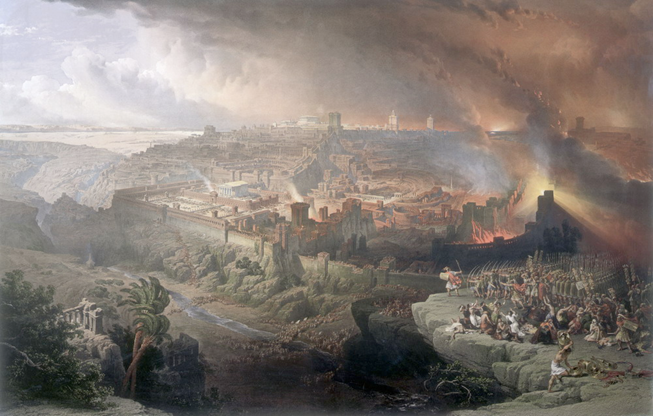
In the gospel story, Jesus declares, "I came to bring fire to the earth, and how I wish it were already kindled!" (Luke 12:49) John the Baptist says of Jesus that he, "will baptize you with the Holy Spirit and fire." (Matthew 3:11)
It is significant that the outpouring of the Holy Spirit, the power that energised the first believers, is linked to the theme of fire.
To explain the link, the writer of Acts has Peter quote the Old Testament prophet, Joel. Peter allegedly spoke these words to explain the phenomena of Pentecost witnessed in Jerusalem after the ascension of the saviour.
In the last days it will be, God declares, that I will pour out my Spirit upon all flesh, and your sons and your daughters shall prophesy, and your young men shall see visions, and your old men shall dream dreams. Even upon my slaves, both men and women, in those days I will pour out my Spirit; and they shall prophesy. And I will show portents in the heaven above and signs on the earth below, blood, and fire, and smoky mist. The sun shall be turned to darkness and the moon to blood, before the coming of the Lord's great and glorious day. (Acts 2:17-20)
The portents of blood, fire and smoke are designated signs of the last days and actually appeared when Jerusalem was consigned to the flames. Peter's speech refers to a contemporaneous event. The baptism by fire was experienced by believers who were trapped in Jerusalem.
Josephus says,
Yet was the misery itself more terrible than this disorder; for one would have thought that the hill itself, on which the temple stood, was seething hot, as full of fire on every part of it, that the blood was larger in quantity than the fire, and those that were slain more in number than those that slew them; for the ground did nowhere appear visible, for the dead bodies that lay on it. ...but they [the Romans] ran everyone through whom they met with, and obstructed the very lanes with their dead bodies, and made the whole city run down with blood, to such a degree indeed that the fire of many of the houses was quenched with these men's blood. And truly so it happened, that though the slayers left off at the evening, yet did the fire greatly prevail in the night.1
Indeed, what Isaiah had prophesied was fulfilled.
And they shall go out and look at the dead bodies of the people who have rebelled against me; for their worm shall not die, their fire shall not be quenched, and they shall be an abhorrence to all flesh. (66:24)
Notes
1. Wars of the Jews 6.403--408.
_
This argument identifies the "Baptism by Fire" and the Pentecostal portents of "blood, and fire, and smoky mist" not as metaphors for spiritual fervour, but as literal descriptions of the Burning of Jerusalem in AD 70.
The strength of this argument lies in its historical literalism. While the "fire" of Pentecost is traditionally viewed as the tongues of flame in Acts 2, the citation of Joel 2:30 specifically lists "blood, and fire, and smoky mist" as signs of the "Day of the Lord." Josephus's account of the Temple Mount "seething hot" and the city "running down with blood" provides a visceral, one-to-one correspondence with the imagery in Peter's speech. If the "Baptism by Fire" refers to the literal conflagration of the city, it positions the birth of the "Spirit-energized" Church not in a peaceful upper room in AD 30, but in the traumatic survival of the AD 70 siege.
The weakness is that in Matthew 3:11, John the Baptist contrasts water baptism with a personal baptism of fire, which is usually interpreted as internal purification or judgment. To accept the revisionist view, one must see the Gospel and Acts narratives as "theological journalism" that took the literal fire of the Roman war and re-cast it as the mystical fire of a new religion.
If the orthodox thesis--that the "fire" of Acts 2 occurred in AD 30--were correct, we should see:
• A Lack of Physical Catastrophe: In AD 30, there was no "blood, fire, and smoky mist" in Jerusalem. If Peter quoted Joel to explain a few men speaking in tongues, the quote is an immense rhetorical overreach. However, if he spoke it while the city was actually burning, the quote is an accurate description of his surroundings.
• Distinct Symbolism: Early Christian art and writing should distinguish between the "Good Fire" of the Spirit and the "Bad Fire" of the Temple's destruction. Instead, we see Jesus in Luke 12:49 wishing for the fire to be already kindled, suggesting the destruction was the goal of his mission.
• The "Sun and Moon" Omens: Joel (and Peter) mentions the sun turning to darkness and the moon to blood. Josephus and Tacitus record exactly these types of celestial portents during the Jewish War (as discussed in Item 13).
Paul collected money from the diaspora Church to help the poor saints in Jerusalem.
They [the Jerusalem elders] requested only that we remember the poor, the very thing I also was eager to do. (Galatians 2:10)
For Macedonia and Achaia are pleased to make some contribution for the poor among the saints in Jerusalem. (Romans 15:26)
Poverty would have been the norm in Jerusalem and indeed throughout Palestine after the War. Wilson names economic collapse as one result of the War, "exacerbated by the awarding of lands to Roman veterans."1
Notes
1. Wilson, 1995, p.3.
_
This argument suggests that the famous "collection for the saints" mentioned in Paul's letters reflects the widespread economic devastation in Judea following the First Jewish-Roman War (AD 66-73), rather than a localized famine in the AD 40s.
The strength of this argument is its alignment with macro-economic reality. While the Book of Acts mentions a famine under Claudius (c. AD 46), the destruction of Jerusalem in AD 70 caused a total societal and economic collapse. The Romans confiscated ancestral lands to reward veterans, effectively turning the surviving Judean population into a class of destitute tenant farmers or urban paupers. If Paul's primary mission was a massive, multi-province fundraising effort for "the poor in Jerusalem," it matches the scale of the post-war humanitarian crisis much more logically than a mid-century regional drought.
The weakness is that the "poor" (ptōchoi) in Jerusalem often referred to a specific sectarian identity (the Ebionites, or "The Poor") rather than just a socioeconomic status. Paul's collection could have been a "temple tax" equivalent intended to support the leadership of the movement in Jerusalem, regardless of the general economic climate. Furthermore, if Paul was writing in the 80s or 90s, the "Jerusalem Church" he was supporting would have to be the community in exile (likely in Pella or the Decapolis), yet he specifically names "Jerusalem."
If the orthodox thesis--that Paul's collection occurred in the AD 50s--were correct, we should see:
• Evidence of a Self-Sustaining Community: A pre-war Jerusalem church should have been able to support itself through the "sharing of all things" mentioned in early Acts. A sudden, desperate need for international aid suggests a catastrophic event that wiped out their internal resources.
• Specific References to the Famine: Paul's letters to the Romans or Corinthians should mention the "famine of Claudius" as the reason for the collection. Instead, he speaks of the "need" in general terms, which fits a permanent state of post-war poverty better than a temporary weather event.
There is a passage in Matthew (11:12), where Jesus is reported to have said:
From the days of John the Baptist until now the kingdom of heaven (βασιλεία τῶν οὐρανῶν) has suffered violence, (βιάζεται -is forcibly seized) and the violent take it by force (βιασταὶ ἁρπάζουσιν αὐτήν -violent men seize or snatch it by force).
According to Josephus the first futile and violent attempt to set up a Jewish kingdom after the death of John the Baptist (c. 36 CE) was the movement led by Theudas, which occurred around 44-46 CE.1 The Book of Acts at 5:36 appears to mention the same incident and oddly describes it as occurring "some time ago..." (πρὸ τούτων τῶν ἡμερῶν) before the present that is before the martyrdom of Stephen and the conversion of Paul which are popularly dated to c. 35 CE. After the incident with Theudas came the "Egyptian" who is also referred to in Acts though much later at 21:38. This attempt occurred, according to Josephus, during the procuratorship of Antonius Felix (c. 52--60 CE).2
The pattern of these insurrections culminated in the general rebellion of 66-70, and effectively ceased when the Temple was destroyed and Jerusalem was taken. Other attempts at setting up a Jewish kingdom occurred after this--in 115 and 130, but assuming the gospel of Matthew was written before 115, we can adduce this passage to confirm that Jesus did not "appear" until much later than the traditional 30-33 AD and most probably at or after the full scale rebellion was crushed in the year 70.
Notes
1. Antiquities of the Jews 20.97--98. According to the historian, Theudas persuaded a large number of followers to take their possessions and follow him to the Jordan River, promising that he would divide its waters at his command---echoing the biblical miracle of Joshua and implying a new exodus and liberation of the people.
2. The Jewish War 2.261--263 and Antiquities of the Jews 20.169--172.
This argument focuses on a cryptic saying in Matthew 11:12 to suggest that the "Kingdom of Heaven" (the Jewish messianic movement) was being seized by literal, violent revolutionaries in a sequence that only began after the traditional life of Jesus.
The strength of this argument is its alignment with the historical timeline of Jewish insurgency. Josephus provides a clear list of "violent men" (biastai) who attempted to forcibly establish the Kingdom of God through armed revolt: Theudas (c. 44--46 CE), the "Egyptian" (c. 52--60 CE), and finally the Zealot factions of the Great Revolt (66--70 CE). If Jesus says the Kingdom has been suffering violence "from the days of John the Baptist until now," and those violent attempts only began in the mid-40s, the "now" of the speaker must be significantly later than 33 CE. The passage in Acts 5:36 further complicates the orthodox timeline by placing Theudas before the 30s CE, a chronological blunder that revisionists argue reveals the text's late, confused attempts to retro-date these events.
The weakness is that many theologians interpret "suffering violence" in a spiritual or metaphorical sense. They argue Jesus was referring to the enthusiastic, perhaps over-eager, crowds "pressing in" to the kingdom, or the spiritual opposition from the establishment. However, the Greek verb harszpazousin (to snatch or seize) almost always implies a predatory or forceful taking, which supports the idea of literal rebels trying to "force" the arrival of the messianic age.
If the orthodox thesis--that Jesus spoke these words in 30 CE--were correct, we should see:
• A Lack of Pre-30 Insurgents: Between the death of Herod the Great (4 BCE) and the 30s CE, Judea was relatively stable under Roman prefects like Pilate. There were no major "violent men" attempting to seize the kingdom during this window. The "violence'" Jesus describes has no historical referent in the 20s CE.
• Chronological Accuracy in Acts: If the author of Acts were a contemporary of Paul, he would not place the revolt of Theudas (44 CE) before the speech of Gamaliel (early 30s CE). This error suggests the author was writing much later and was poorly informed about the specific dates of the mid-century.
• Contextual Clarity: If Jesus meant "spiritual violence," we would expect the surrounding verses to explain this unique concept. Instead, the passage stands as a jagged historical fragment that matches the "Sign of the Sword" (Item 14) and the general chaos of the 60s CE.
At Jesus' trial before the Council, Matthew says,
Now the chief priests and the whole council were looking for false testimony against Jesus so that they might put him to death, but they found none, though many false witnesses came forward. At last two came forward and said, "This fellow said, 'I am able to destroy the temple of God and to build it in three days.'" (26:59-61)
This so-called "false" testimony contains a kernel of truth. The destruction of the physical temple created the conditions for the building of a new temple, the church.1 And the temple "made without hands" (Mark 14:58) was planted in the same place as the old temple was destroyed, Jerusalem. (Acts 6:7) The "three days" refers to the time Jesus was in the grave. When he rose from the dead, the church was symbolically founded. The falsity of the claim lies in a misunderstanding on the part of the witnesses. The linking of the two events in time and place is significant.
Notes
1. Paul says, 'For God's temple is holy, and you [plural] are that temple.' (1 Corinthians 3:17)
_
This argument explores the "destruction/reconstruction" paradox central to the Gospel narrative. It suggests that the "false testimony" regarding Jesus's threat to destroy the Temple is a literary device used to reconcile the historical trauma of 70 CE with the emergence of the Church.
The strength of this argument is its metaphorical resolution. In the trial scene, the witnesses are labeled "false" not because Jesus didn't talk about Temple destruction, but because they understood it as a literal threat by a single man rather than a divine "re-planting" of the faith. By linking the destruction of the physical stones to a "three-day" resurrection, the Gospel writers (writing after 70 CE) provided a theological "why" for the ruins of Jerusalem. The "temple made without hands" (Mark 14:58) is the ultimate answer to the "Prophetic Vacuum" (Item 49)---it explains that the destruction was not an end, but a necessary step to create the "living stones" of the Church (Item 48).
The weakness is the internal logic of the trial. If the testimony was truly "false" in a literal sense, then Jesus never made the claim at all. However, the Gospel of John (2:19) has Jesus openly say, "Destroy this temple, and in three days I will raise it up," though the narrator clarifies he was speaking of "the temple of his body." This suggests that the "falsehood" was a matter of interpretation, not existence.
If the orthodox thesis--that this was a pre-war prediction made in the 30s CE--were correct, we should see:
• A Non-Destructive Reform: Jesus's teachings should have focused on how to save the Temple from corruption while keeping the building intact. Instead, the Gospels are saturated with the inevitability of its total ruin (Matthew 24:2).
• Immediate Reconstruction: If the "new temple" was built in three days in AD 33, the followers of Jesus should have stopped caring about the Herodian Temple immediately. Yet Acts 3:1 shows the apostles still attending the physical Temple for prayer decades later.
• The Markan Clarification: Mark's addition of "made without hands" vs. "made with hands" is a highly sophisticated Greek philosophical distinction. It is the language of a post-70 CE diaspora community trying to explain to a Roman audience why their religion has no physical headquarters.
Now there was a man in Jerusalem whose name was Simeon; this man was righteous and devout, looking forward to the consolation of Israel, and the Holy Spirit rested on him. (Luke 2:25)
This consolation would have been sought AFTER 70 CE, that is after the city, the temple and the country had been laid waste.
_
This argument focuses on the term "The Consolation of Israel" (paraklēsin tou Israēl), suggesting that the specific hope expressed by the character Simeon in the Nativity narrative is a post-war sentiment rather than a pre-war expectation.
The strength of this argument lies in its contextual resonance. While the "consolation" of Israel is rooted in the "Comfort" passages of Isaiah (e.g., Isaiah 40:1), the desire for such comfort reached its historical zenith only after the catastrophic loss of the Temple and the Jewish state in AD 70. In Jewish liturgy and literature of the late first century (such as 2 Baruch and 4 Ezra), "consolation" became a technical term for the mourning over Jerusalem's ruins. By placing this longing in the mouth of Simeon at the beginning of the Gospel of Luke, the author effectively signals to a post-70 audience that the birth of Jesus is the divine response to the national grief they are currently experiencing.
The weakness is that the hope for a Messiah ("the consolation") was already a staple of Jewish thought during the Roman occupation under the Herods. A traditional scholar would argue that the "righteous and devout" in the 4 BCE-30 CE period were looking for consolation from the general "shame" of being ruled by pagans, even if the Temple was still standing.
If the orthodox thesis--that Simeon's hope was a generic pre-war messianic expectation--were correct, we should see:
• A Focus on "Restoration" vs. "Consolation": Pre-war expectations usually centred on the Restoration (apokatastasis) of the Kingdom---a proactive, political triumph (as seen in Acts 1:6). "Consolation" is the language of a funeral; it implies a loss has already been sustained.
• The Absence of Post-War Vocabulary: If Luke were writing in the 60s, we should not see him using the specific "comfort" themes that define post-70 rabbinic and apocalyptic literature. Instead, Luke 2 mirrors the tone of the "Lamentations" over the fallen city.
• A Simeon with Immediate Impact: In the narrative, Simeon says his eyes have seen salvation, yet in the orthodox timeline, the city is destroyed forty years later. This creates a paradox where the "consolation" arrives, but the greatest tragedy in Israel's history follows immediately after.
Luke has the disciples say, "Lord, is this the time when you will restore the kingdom to Israel?" (Acts 1:6) This passage would only have made sense in the 70s, that is after Israel had been destroyed as a political state: not the 30s.
_
This argument highlights the anachronism of political restoration in the early chapters of Acts. It suggests that the disciples' primary concern--the "restoration of the kingdom"--only becomes a logical and urgent question once that kingdom has been physically annihilated.
The strength of this argument lies in its political logic. In the AD 30s, the "Kingdom of Israel" (as a concept of self-rule) was certainly under Roman prefecture, but the Jewish social, religious, and political infrastructure---the Sanhedrin, the High Priesthood, and the Temple---was fully intact. The desperate question, "Will you *at this time* restore the kingdom?" carries the weight of a people who have recently lost everything. In the wake of AD 70, when the Jewish state had been completely liquidated, the hope for a miraculous "restoration" (as seen in contemporary works like 4 Ezra) was the defining obsession of the survivors.
The weakness is the Zionist expectation common throughout the Second Temple period. Many Jews in the 30s viewed Roman rule itself as a state of "exile" and "destruction," even with the Temple standing. For them, restoration meant the removal of the Roman eagle and the return of a Davidic monarch. Therefore, a traditional scholar would argue the question is perfectly consistent with the messianic fervour of the AD 30s.
If the orthodox thesis--that this conversation happened in AD 30--were correct, we should see:
• A Focus on Reform, Not Restoration: If the kingdom existed but was merely "occupied," the disciples should have asked about "cleansing" or "liberating" the current state. "Restore" (apokathistaneis) implies bringing something back that has been lost or broken.
• A Pre-70 Footprint for the Book of Acts: If Acts was written by a contemporary of Paul in the 60s, it should not be so deeply coloured by the "post-apocalyptic" language of the 70s and 80s. Instead, Acts ends abruptly without mentioning the war, which revisionists argue is a deliberate literary choice to maintain the "synced" (but artificial) timeline of the AD 30s.
• Contextual Alignment with the 70s: The question in Acts 1:6 is immediately followed by the promise of the Holy Spirit and "witnessing" in Jerusalem. As seen in Item 24, this "Spirit" and "Fire" are tied to the literal ruins of AD 70.
Paul quotes from an anonymous text called Biblical Antiquities that was written after the year 70, as it refers to the date Jerusalem was taken by Titus.1
This is the passage in Paul's first letter to the Corinthians:
But, as it is written, 'What no eye has seen, nor ear heard, nor the human heart conceived, what God has prepared for those who love him' -- these things God has revealed to us through the Spirit. (2:9-10)
This passage does not occur in the Old Testament2 but does occur in Biblical Antiquities3.
The phrase as it stands could have been in common use before the year 70, but why would Paul say, "as it is written" if he did not have in mind a particular written text?
Notes
1. "I will show thee the place wherein the people shall serve me 850 (MSS. 740) years, and thereafter it shall be delivered into the hands of the enemies, and they shall destroy it, and strangers shall compass it about; and it shall be on that day like as it was in the day when I brake the tables of the covenant which I made with thee in Horeb: and when they sinned, that which was written thereon vanished away. Now that day was the 17th day of the 4th month." Dr. Cohn's comment is: "These words are meant to signify that Jerusalem was taken on the 17th of Tamuz, on the same day on which the Tables of the Law were broken by Moses. The capture of Jerusalem by the Babylonians, however, took place on the 9th of Tamuz (Jer. 52:6; Cf. 2 Kings 25:3). The . . . 17th of Tamuz can relate only to the second temple (read capture) as it is expressly mentioned in the Talmud (Taanith IV. 6, cf. Seder Olam Rabbah, cap. 6 and 30) that on that date the Tables of the Law were destroyed and Jerusalem was taken by Titus. Thus the author betrays himself by giving as the date of the capture of Jerusalem by the Babylonians what is really the date of the capture by Titus." The Biblical Antiquities of Philo -- M. R. James, 1940.
2. A similar but different passage is found in Isaiah 64:4. "From ages past no one has heard, no ear has perceived, no eye has seen any God besides you, who works for those who wait for him."
3. "And then will I take them and many other better than they, from that place which eye hath not seen nor ear heard neither hath it come up into the heart of man, until the like cometh to pass unto the world, and the just shall have no need for the light of the sun nor of the shining of the moon, for the light of the precious stones shall be their light." (26:12)
_
This argument provides a potential "literary smoking gun" by identifying a source for Paul's writing that contains an internal date post-dating the fall of Jerusalem in AD 70.
The strength of this argument is its focus on the specific phrase "as it is written." In the New Testament, this formula almost always introduces a formal citation of a written text, yet the quote in 1 Corinthians 2:9 is nowhere to be found in the Hebrew Bible or the Septuagint. It does, however, appear in Biblical Antiquities (Pseudo-Philo). Crucially, Biblical Antiquities (19:7) contains a chronological calculation for the destruction of the Temple that aligns perfectly with the 17th of Tammuz---the specific date the Talmud records for the breach of Jerusalem's walls by Titus in AD 70. If Paul is quoting this text as an established authority, his letters must have been composed late enough for Biblical Antiquities to have been written, circulated, and recognized as "Scripture."
The weakness is that many scholars believe both Paul and *Biblical Antiquities* were drawing from a now-lost Jewish apocryphal work (such as the Ascension of Isaiah or the Apocalypse of Elijah) or a common oral tradition. If such a common source existed before AD 70, then Paul's use of the phrase doesn't necessarily anchor him to the post-70 era. Additionally, the similarity to Isaiah 64:4 leads many traditionalists to argue Paul was simply providing a "loose" or "paraphrased" combination of Old Testament verses.
If the orthodox thesis--that Paul wrote 1 Corinthians in the mid-AD 50s--were correct, we should see:
• A Clear Old Testament Citation: Paul usually cites the Law or the Prophets with precision. If he meant Isaiah 64, he likely would have stayed closer to the Septuagint text. His departure suggests he is looking at a different, specific scroll.
• The Absence of Post-70 Synchronicities: We should not find Paul consistently using the vocabulary and "secret wisdom" motifs that defined Jewish literature after the disaster of AD 70.
• A "Pre-70" Version of Biblical Antiquities: If the text Paul quoted was truly ancient, we should find versions of Biblical Antiquities that do not include the specific "Titus" date (17th of Tammuz). Instead, the date appears central to the work's historical perspective.
Counting from Augustus, the seventh emperor in Rome was Titus if we leave out the three who reigned briefly in 68-69. (Galba, Otho and Vitellius) The great red dragon of Revelation chapter twelve has seven heads and ten horns. The reference could be to Titus, who was responsible for the destruction of Jerusalem and the Temple. John says, "His tail swept down a third of the stars of heaven and threw them to the earth." (v.4) Then the dragon stands before a pregnant woman who is about to give birth in order to devour the child of the woman. The child is born and is snatched away to God and to his throne. It is clear from the context that the child is the potential political Messiah, Jesus.
Later we are told that:
. . . the dragon was angry with the woman, and went off to make war on the rest of her children, those who keep the commandments of God and hold the testimony of Jesus. (v.17)
The woman's other children are Christians persecuted by the Roman authorities. The imagery suggests that Jesus is born during the reign of the dragon which has seven heads, that is Titus.
_
This argument utilizes the apocalyptic symbolism of Revelation 12 to propose a radical chronological shift: that the "birth" of Christ is a mystical event occurring during the reign of Titus (AD 79-81), the conqueror of Jerusalem.
The strength of this argument lies in its historical numerology. If one excludes the three "usurper" emperors of the chaotic civil war of AD 68-69 (Galba, Otho, and Vitellius), the sequence of Roman Emperors is: 1. Augustus, 2. Tiberius, 3. Caligula, 4. Claudius, 5. Nero, 6. Vespasian, and 7. Titus. In Revelation 12, the Great Red Dragon has seven heads, often interpreted as the Seven Hills of Rome or its seven kings. If Titus is the "Seventh Head," and the Dragon is poised to devour the child at the moment of birth, the text implies that the "Jesus event" is a phenomenon contemporary with the Flavian dynasty. This would explain why the "child" (Jesus) is immediately "snatched away to God"--it reflects a movement that exists primarily in heaven/spirit because its physical manifestation (the Jewish state) was devoured by Rome.
The weakness is the highly interpretive nature of Revelation. Apocalyptic literature is notoriously flexible. Traditionalists argue the "woman" is Israel or the Church, and the "birth" is the historical Nativity in the time of Augustus, with the Dragon representing the Roman power in a general sense (or specifically Herod). Furthermore, excluding three emperors to make the math fit "Titus as the seventh" can be seen as "data mining" to fit a specific theory, although the Romans themselves often viewed the Flavians as the true successors to the Julio-Claudians.
If the orthodox thesis--that Revelation 12 is a symbolic retelling of a birth in 4 BCE--were correct, we should see:
• A "Sixth Head" Context: The text says, "five [kings] have fallen, one is, the other has not yet come" (Rev 17:10). If the "one who is" was Nero (the 6th), the "Seventh" who is to come would be Vespasian or Titus. If the birth happens under the "Seventh," it must be post-Nero.
• Herodian Imagery: If the birth were in 4 BCE, we would expect symbols of the Judean monarchy. Instead, the enemy is a "Great Red Dragon" with specifically Roman attributes (seven heads/ten horns), suggesting the primary threat at the time of "birth" was the Imperial power that destroyed the Temple.
• The "War on the Rest of her Children": Verse 17 mentions the dragon making war on those who "hold the testimony of Jesus." This implies that the "testimony" and the "birth" are happening in the same historical window of Roman persecution (late 1st century).
Barth, M. (1974). Ephesians: Introduction, translation and commentary on Chapters 1--3. Garden City, N.Y: Doubleday.
Buckley, J. J. (2002). The Mandaeans: ancient texts and modern people. Oxford: Oxford University Press.
Conder, C. R., & Palestine Exploration Fund. (1998). The survey of Western Palestine, 1882-1888: [2]. Slough: Archive Editions in association with Palestine Exploration Fund.
Kitchen, M. (2002). Ephesians. London: Routledge.
Metzger, B. M. (1987). The canon of the New Testament : its origin, development, and significance. Clarendon Press; Oxford University Press.
Murphy-O'Connor, J. (2007). Jesus and Paul : parallel lives. Liturgical Press.
Parvis, S. (2006). The martyrdom of Polycarp. The Expository Times, 118(3), 105-112.
Pearson, B. (1971). 1 Thessalonians 2:13-16: A Deutero-Pauline Interpolation. The Harvard Theological Review, 64(1), 79-94.
Puech, E. (2008). The prestige of the pagan prophet Balaam in Judaism, early Christianity and Islam. In Bala'am and deir 'Alla (pp. 25-47). Leiden-Boston: Brill.
Saffrey, H. D. (2007). Paul (Saül), un juif de la diaspora. Revue des Sciences Philosophiques et Théologiques, Tome 91(2), 313-322.
Stark, R., & Mazal Holocaust Collection. (1996). The rise of Christianity: A sociologist reconsiders history. Princeton, N.J: Princeton University Press.
Wilson, S. G. (1995). Related strangers: Jews and Christians, 70-170 C.E. Minneapolis, MN: Fortress Press.
The Epistle of Barnabas is preserved complete in the 4th century Codex Sinaiticus where it appears at the end of the New Testament. There is evidence that the author was the notable companion and fellow of the apostle Paul, as we see for example in Galatians 2:1,9.1
Jerome testifies that:
Barnabas the Cyprian, also called Joseph the Levite, ordained apostle to the Gentiles with Paul, wrote one Epistle, valuable for the edification of the church, which is reckoned among the apocryphal writings.2
This letter was widely accepted as genuine by the early church fathers, for example Clement of Alexandria:
Barnabas, too, who in person preached the word along with the apostle in the ministry of the Gentiles, says, I write to you most simply, that you may understand.3
Furthermore, it is evident that Barnabas wrote his epistle after the year 70, because he talks about the destruction of the temple as a fait accompli. (16:3-4)
Barnabas' intention in the whole chapter [16] is to show that a transposition has taken place---from a literal Temple that has (rightfully, in his opinion) been destroyed to a spiritual temple that should be understood in Christian terms. The ideas of remission of sin, hope in the Name, and the new creation in which God dwells (xvi. 8, 9), show that Barnabas is speaking about a Christian replacement for the destroyed Temple.4
In his eschatology, Barnabas, referencing Daniel, speaks of three kings being subdued by one king. (4:4) This seems to indicate that he was writing in the time of the one king, that is Nerva, who succeeded the Flavian dynasty of the three kings, that is Vespasian, Titus and Domitian in the year 96.5
Notes
1. Also 1 Corinthians 9:6 and Colossians 4:10.
2. De Viris Illustribus, 6.
3. Stromata, Book 5.10.
4. Richardson & Shukster, 1983, p.34.
5. Ibid., p.53-55.
_
This argument utilizes the Epistle of Barnabas to bridge the gap between the original Apostles and the post-AD 70 world. It suggests that a primary companion of Paul was still active and writing as late as the reign of Nerva (AD 96-98), fundamentally shifting the "Apostolic Age" into the late first century.
The strength of this argument is the explicit internal evidence regarding the Temple. Barnabas 16:3-4 refers to the Temple's destruction as a past event caused by "fighting" and "enemies," which perfectly matches the Roman siege of AD 70. Furthermore, the correlation of the "three kings being subdued by one" with the transition from the Flavian Dynasty (Vespasian, Titus, and Domitian) to the emperor Nerva provides a precise chronological anchor. If the early church was correct in attributing this letter to the biblical Barnabas, it proves that Paul's inner circle lived through the war and developed "Replacement Theology" as a direct response to the Temple's ruins.
The weakness is the tension between tradition and modern scholarship. While Clement of Alexandria and Jerome accepted Barnabas as the author, most modern critics view the letter as "pseudonymous" (written by someone else using his name1). They argue the anti-Jewish tone of the letter is inconsistent with the Barnabas described in Acts. However, the revisionist view argues that the "Apostolic" label was only given to those who were present at the movement's inception---meaning if Barnabas is an Apostle, and Barnabas is writing in AD 96, the movement's "inception" cannot be AD 30.
If the orthodox thesis--that the Apostles died out in the 60s and the Temple was still standing during their ministry--were correct, we should see:
• Pre-War Pauline Letters: We should find early apostolic letters expressing concern for the Temple's daily rituals. Instead, the "Apostolic" Epistle of Barnabas argues that the physical Temple was a mistake from the beginning and that its destruction was a divine "remission of sin."
• Chronological Silences: We should see a 30-year "black hole" in Christian writing between AD 70 and AD 100. Instead, we have works like the Epistle of Barnabas, which link the two eras through a single historical figure (Barnabas the Levite).
• Clear Rejection by the Church: If this was a late forgery, the early Church should have rejected it as an anachronism. Instead, it was found at the end of the Codex Sinaiticus, effectively treated as the 28th book of the New Testament.
Notes
1. Metzger, 1987, p.56.
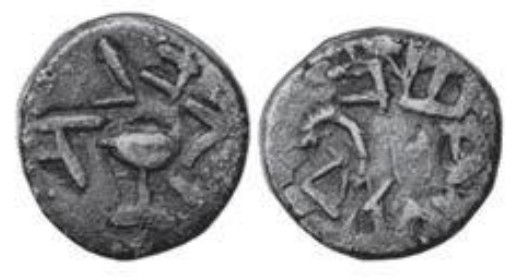
The phrase "the redemption of Jerusalem", a catchcry during the revolt turns up in the gospel of Luke and also on a coin minted in Gamla, in northern Galilee, around 66 CE. The capture and destruction of Gamala/Gamla and its inhabitants is reported in great detail by Josephus.1
Luke says:
At that moment she [the prophetess Anna] came, and began to praise God and to speak about the child [Jesus] to all who were looking for the redemption2 of Jerusalem. (Luke 2:38)
At Gamla a rare bronze coin has been discovered. Nine specimens of the type are known, seven from the excavations of Gamla. The dies are very crudely cut, obviously done under improvised conditions and by an unskilled artisan. The obverse shows a chalice, in clear imitation of the Jerusalem sheqels, which are generally accepted as showing one of the Temple utensils. The inscription, mixing paleo-Hebrew and Aramaic script, encircles the cup and continues on the blank reverse: "For the redemption of Jerusalem the Holy."3
Notes
1. Wars of the Jews 4.1-83.
2. From the Greek: lutrósis (λύτρωσις) properly the payment of the ransom-price to free a slave, for example Leviticus 25:47-55. Also, deliverance or redemption in the theocratic sense, as per Hebrews 9:12. Only three instances of the word occur in the New Testament. Two are in Luke and the other is in Hebrews.
3. Syon, 2014, p.120-122.
4. Ibid., p.122.
_
This argument identifies a specific political slogan-- "The Redemption of Jerusalem"--and links its appearance in the Gospel of Luke to the literal propaganda of the First Jewish Revolt (AD 66-70). It suggests that the language used to describe the Messianic hope in the New Testament is identical to the revolutionary rhetoric found on insurgent coinage.
The strength of this argument lies in its archaeological and linguistic precision. The phrase lytrosis Ierousalem (λύτρωσιν Ἰερουσαλήμ) is not a common biblical phrase; it appears as a specific "state motto" on crudely struck coins in the besieged city of Gamla. Finding this exact phrase in Luke 2:38 anchors the text to a specific historical crisis. When the prophetess Anna speaks of Jesus to those "looking for the redemption of Jerusalem," she is using the contemporary vernacular of a revolutionary movement. This implies that the Gospel writer was either writing during the war or was intentionally using the political language of the AD 60s to frame the significance of Jesus.
The weakness is that the concept of "redemption" (lytrosis) has deep roots in the Septuagint and Hebrew Bible (e.g., Psalm 130:8). Traditional scholars argue that the rebels in AD 66 simply adopted an existing religious concept for their coins, just as Luke used it to express spiritual salvation. In this view, the similarity is due to a shared religious vocabulary rather than the Gospel being a product of wartime propaganda.
If the orthodox thesis--that this was a peaceful religious hope in 4 BCE--were correct, we should see:
• Pre-War Precedent: The phrase "Redemption of Jerusalem" should appear on coins or inscriptions from the eras of Herod the Great or the Maccabees. Instead, it surfaces specifically and uniquely during the Great Revolt against Rome.
• Alternative Vocabulary: If the "redemption" was purely spiritual, we might expect terms for "salvation from sin" (soteria). Instead, Luke uses the exact political/ransom language (lytrosis) used by those fighting to liberate a city under Roman siege.
• Roman Indifference: If the term was harmlessly religious, the Romans would not have felt the need to counter it. Instead, they issued the "Judaea Capta" coins in AD 71, which served as a direct ideological rebuttal---showing the city not "redeemed," but conquered and enslaved.
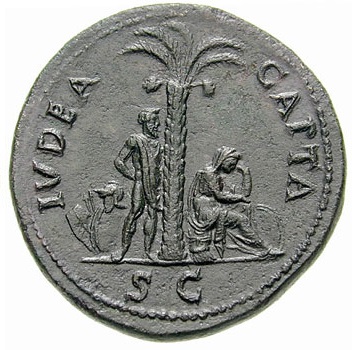
In the Koran at Surah 19 (Surah Maryam) we read:
19. (The angel) said [to Mary]: "I am only a Messenger from your Lord, (to announce) to you the gift of a righteous son."
20. She said: "How can I have a son, when no man has touched me, nor am I unchaste?"
21. He said: "So (it will be), your Lord said: 'That is easy for Me (Allah): And (We wish) to appoint him as a sign to mankind and a mercy from Us (Allah), and it is a matter (already) decreed, (by Allah).'"
22. So she conceived him, and she withdrew with him to a far place.
23. And the pains of childbirth drove her to the trunk of a date-palm. She said: "Would that I had died before this, and had been forgotten and out of sight!"
24. Then [the babe 'Iesa (Jesus) or Jibrael (Gabriel)] cried unto her from below her, saying: "Grieve not! Your Lord has provided a water stream under you;
25. "And shake the trunk of date-palm towards you, it will let fall fresh ripe-dates upon you."
26. "So eat and drink and be glad, and if you see any human being, say: 'Verily! I have vowed a fast unto the Most Beneficent (Allah) so I shall not speak to any human being this day.'"
27. Then she brought him (the baby) to her people, carrying him. They said: "O Mary! Indeed you have brought a thing Fariya (an unheard mighty thing).1
As interpreted by Islam, the angel Gabriel, the date palm, the water stream and Mary the mother of Jesus are depicted on more than one series of Roman coins first minted in the year 71.
Another version of this story, also based on the coin motifs, is found in The Gospel of Pseudo-Matthew. This Latin text originated in the sixth or seventh centuries, about the same time as the Koran was written. In this version Mary is escaping to Egypt with the baby Jesus and being "fatigued by the excessive heat of the sun in the desert" rests under a palm tree. The man in the scene is not an angel but this time it is Joseph. In the story, the child Jesus commands the palm tree to bend down and provide fruit for his mother. When the tree rises again it releases "a spring of water exceedingly clear and cool and sparkling."2
A Judaea Capta coin minted in 71 CE---showing a mourning woman beneath a date palm---could have acquired a counter-reading among post-war Jewish-Christian (possibly Ebionite) groups east of the Jordan.3 In such circles, "the woman" becomes the mother of the Messiah. Once that symbolic reading takes hold, it can travel orally across the Decapolis--Nabataean corridor. These groups are insulated from the standard birth stories found in Matthew and Luke.
That coins were used to settle questions of doctrine is illustrated by Matthew's use of the Roman denarius in the teaching of Jesus about paying taxes. (22:17-21) In Lucian's study of the religion of Astarte-Europa in Sidon he calls as witness the coinage of the district.4
Notes
1. Accessed at 19. Surah Maryam — NobleQuran.com
2. The Gospel of Pseudo-Matthew, 20 accessed at [www.gnosis.org/library/psudomat.htm](http://www.gnosis.org/library/psudomat.htm)
3. Puin & Ohlig, 2010, p.365ff.
4. The Syrian Goddess, 4.
_
This argument connects the specific details of the Nativity in the Quran (Surah 19) and the Gospel of Pseudo-Matthew to the imperial iconography of the Judea Capta coins issued by Rome in AD 71. It suggests that the imagery of a defeated nation was subversively "re-coded" by fringe Christian groups into a story of divine birth and deliverance.
The strength of this argument lies in the uncanny visual match between the Roman coin and the Quranic text. In AD 71, the most common image in the Roman world was a mourning woman (representing Judaea) sitting in despair beneath a date palm, often with a spring of water or a victorious male figure nearby.
The Quranic account mirrors these exact components: Mary is in a "far place," in despair ("Would that I had died!"), beneath a date palm, with a stream of water provided at her feet. This theory suggests that groups like the Ebionites--isolated from the "manger" tradition of Matthew and Luke--used the omnipresent Roman coin as a visual aid to tell a new story: the woman is not "conquered Israel," but "Mary/Zion" giving birth to the Messiah despite Rome's power.
The weakness is the chronological gap between the 1st-century coins and the 7th-century Quran. While the theory of "catechetical icons" (using images to teach) explains how a visual motif survives, it requires us to view the Quranic narrative as the end-product of centuries of oral evolution within fringe, non-orthodox Christian circles in the Arabian and Syrian deserts.
If the orthodox thesis--that the Quranic story is an independent revelation of a historical event in 4 BCE--were correct, we should see:
• Consistency with Canonical Gospels: If the "palm tree" was the actual site of the birth, it should appear in the earlier accounts of Matthew or Luke. Its absence suggests it is a later development rooted in a different visual context.
• Lack of Despair Imagery: The Mary of the canonical Gospels is humble but not suicidal. The Mary of the Quran, who wishes she "had been forgotten," perfectly matches the "Mourning Judaea" (Judaea Capta) figure on the coins.
• Alternative Botanical Symbols: If the story were generic, any tree (oak, cedar, olive) would suffice. The specific insistence on the Date Palm---the Roman botanical shorthand for the province of Judaea---strongly suggests the story was "born" from Roman propaganda.
Theological disputations between Christians and Jews took place in the Middle Ages and there are detailed records of three of these. The Barcelona Disputation of 1263 before King James of Aragon was recorded by Nahmanides, one of the greatest figures in the history of Jewish learning, and Jewish spokesman at the disputation. He reports as follows:
Fray Paul [the Christian disputant] now resumed, and argued that it is stated in the Talmud that the Messiah has already come. He cited the Aggadah in the Midrash of Lamentations [II:57]: A certain man was ploughing and his cow lowed. An Arab passed by and said to him, "Jew, Jew, untie your cow, untie your plough, untie your coulter, for the Temple has been destroyed." He untied his cow, he untied his plough, he untied his coulter. The cow lowed a second time. The Arab said to him, "Tie up your cow, tie up your plough, tie up your coulter, for your Messiah has been born."1
According to Yehiel another disputant from that era, the Aggadic parts of the Talmud were not regarded as having the same authority as the Halakhic parts. "You may believe them or disbelieve them as you wish, for no practical decision depends on them."2 Nevertheless, the Midrash shows that a Jewish tradition was supported at some time that the coming (or birth) of Jesus was tied to the destruction of the Temple.
Notes
1. Maccoby, 2006, p.110.
2. Ibid., p.37.
_
This argument utilizes a specific Jewish Aggadah (homiletic story) from the Midrash of Lamentations to suggest that an ancient Jewish tradition explicitly synchronized the birth of the Messiah with the destruction of the Second Temple in AD 70.
The strength of this argument is its historical symmetry. In the story of the ploughman, the destruction of the Temple and the birth of the Messiah are two sides of the same coin, occurring in the same narrative moment. For the Christian disputant Fray Paul, this was a "smoking gun" within Jewish literature proving that the Messiah had already come (specifically at the time of the Temple's fall). If this Aggadah preserves a memory from the late 1st century, it supports the revisionist thesis that the "Jesus event" and the "Temple event" are chronologically fused.
The weakness, as pointed out by the Jewish scholar Yehiel, is the nature of Aggadah. Unlike Halakha (binding law), Aggadic stories are often metaphorical, poetic, or intended for comfort rather than historical record. Jewish tradition often uses the idea that "the Messiah was born on the day the Temple was destroyed" as a theological paradox---meaning that in the moment of Israel's greatest despair, the seeds of its future hope were planted. It does not necessarily mean a literal infant was born in AD 70.
If the orthodox thesis--that Jesus was born in 4 BCE and the Temple fell 74 years later--were the only tradition, we should see:
• A Temporal Gap in Tradition: Jewish legends should clearly separate the era of Jesus (the time of Pilate) from the era of the Revolt (the time of Titus). Instead, this Midrash collapses the two into a single day of "untying and tying the plough."
• Messianic Silence in AD 70: If the Messiah had already come and gone decades earlier, the "Arab" in the story would have no reason to announce a new birth at the moment of the Temple's smoke.
• The "Arab" as a Messenger: In the 1st century, "Arabs" (Nabataeans) were often allied with Rome or present during the siege. The choice of an outsider to announce the Messianic birth suggests the news was breaking in the context of the Roman military environment.
A Jewish tradition has Jesus invisibly present in Rome, until he has caused its ruin. In the Vikuah of Nahmanides we read,
Fray Paul asked me [Nahmanides] whether the Messiah of whom the prophets spoke has come, and I said that he has not come. And he cited an Aggadic book in which it is stated that on the day that the Temple was destroyed, on that very day, the Messiah was born.
Nahmanides admits this is true but goes on to say that he does not believe this. After some discussion the King asks; "Where is the Messiah at present?" And after further discussion, "But have you not said, in the Aggadah, that he is in Rome?" Nahmanides replies,
I said to him, 'I did not say that he was permanently in Rome, but that he appeared in Rome on a certain day, for Elijah told that Sage that he would find him there on that particular day, and he did appear there; and his appearance there was for the reason mentioned in the Aggadah, but I prefer not to mention it before such throngs of people.' The matter which I did not wish to reveal to them was what is said in the Aggadah: that the Messiah would remain in Rome until he brought about its ruin. This is just as we find with Moses our teacher, on him be peace, that he grew in the household of Pharaoh until he called him to account and drowned all his people in the sea.1
The ruin of Rome is to be brought about by the Messiah as an act of revenge for the Roman treatment of the Jews and the destruction of Jerusalem. The appearance of the Messiah in Rome occurs after the Jewish revolt.
Notes
1. Maccoby, 2006, p.117.
_
This argument concludes the witness of the Jewish Aggadah, shifting the focus from the timing of the Messiah's birth to his location and purpose. It suggests that the Messiah's "entry" into Rome is a deliberate infiltration designed to bring about the empire's downfall from within.
The strength of this argument lies in the Moses parallel. In Jewish thought, the redeemer often emerges from the heart of the oppressor's household (as Moses did in Pharaoh's palace). If the Messiah is born in Jerusalem in AD 70 and then "appears" in Rome shortly thereafter, it creates a striking parallel with the Flavian hypothesis: that the "Christian" movement was nurtured within the Roman administrative and imperial structure before eventually "overturning" the pagan Roman state. The Aggadah effectively captures the historical irony that the religion born from a Roman victory (AD 70) would eventually become the religion that replaced Rome's gods.
The weakness is the apocalyptic nature of the text. In the Talmud (Sanhedrin 98a), the Messiah is often depicted sitting at the gates of Rome among the poor and the lepers. This is usually interpreted as a sign of the Messiah's humility or his shared suffering with the exiled Jewish people. Nahmanides' interpretation--that he is there to "bring about its ruin"--reflects the defensive and defiant posture of a 13th-century Jewish scholar under pressure from Christian inquisitors, rather than necessarily a literal 1st-century military strategy.
If the orthodox thesis--that Jesus's ministry was entirely completed and he ascended to heaven in AD 33--were the only narrative, we should see:
• A Lack of "Roman" Origins: Jewish tradition should have no reason to place the Messiah in the city of Rome during the 1st century. Instead, we find a persistent Aggadic tradition that he is physically present in the capital of the enemy.
• No Synchronization with the Revolt: If Jesus was the Messiah, his story should be anchored to the time of Pilate. However, the Aggadah insists the Messiah's "Roman" phase begins specifically after the destruction of the Temple (AD 70).
• The "Moses" Model: If the Messiah was purely a victim of Rome, he wouldn't be depicted as a guest in its "household." The Aggadah's insistence on the Moses/Pharaoh parallel suggests the Messiah is a "sleeper agent" within the Roman system.
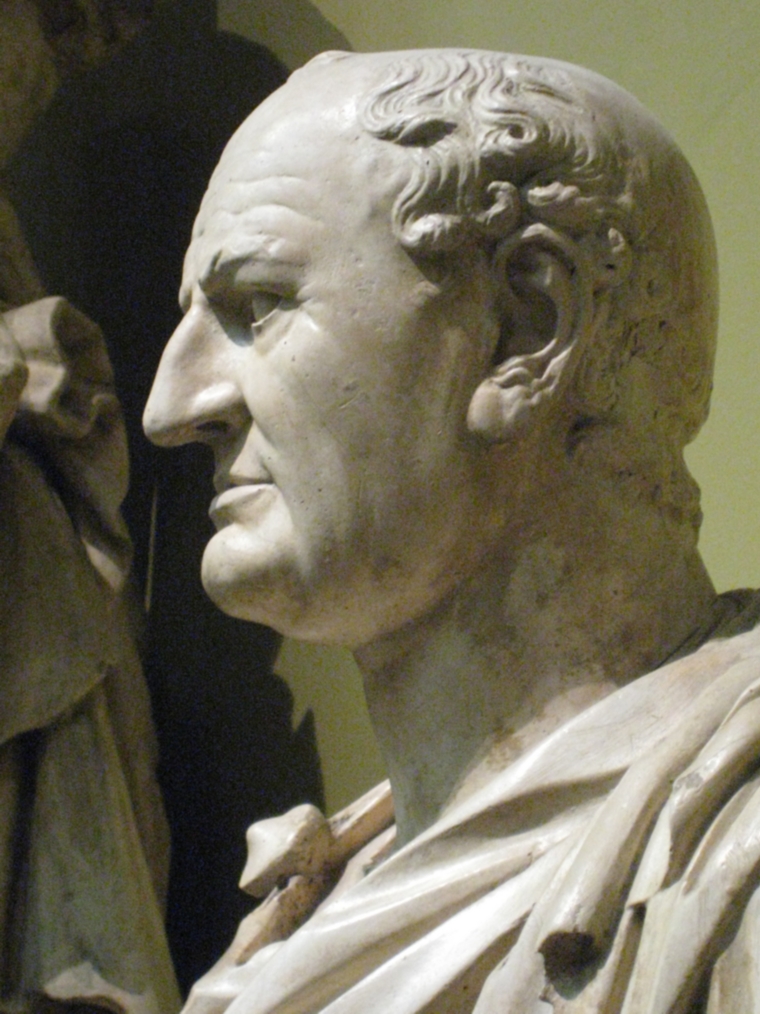
Messianic hopes were highest just prior to the year 66, NOT during the reign of Tiberius. The destruction of the temples in Rome in the great fire of 64 would have been seen as paving the way for a new religion.1
Suetonius records a fervent Messianic expectation during the reign of Vespasian.
A firm persuasion had long prevailed through all the East, that it was fated for the empire of the world, at that time, to devolve on some who should go forth from Judea. This prediction referred to a Roman emperor, as the event shewed; but the Jews, applying it to themselves, broke out into rebellion.2 [italics added]
Also noteworthy is the fact that the prophecy recorded by Suetonius had traction with Gentiles as well as Jews. This would explain the appeal of Christianity to Gentiles who had absorbed these expectations; hence fertile ground for the preaching of Paul and others at that time.
Notes
1. "Nero is thus doubly bad: he does not know how to do religious ritual properly, as we shall see in his handling of the aftermath of the fire, nor can he preserve the temples that are reminders of how to do religious ritual properly." Shannon, 2012, p.750.
2. Suetonius, Vespasian.
The strength of this argument is its alignment with the verified "Persuasion of the East" recorded by Roman historians. While the Gospels place the Messianic climax in the 30s CE, Suetonius and Tacitus both confirm that the "firm persuasion" of a Judean world-ruler reached its fever pitch in the 60s CE. The weakness is the orthodox pushback that the 60s were merely a political manifestation of a spiritual movement started decades earlier. However, the Great Fire of Rome in 64 CE, which destroyed the ancient pagan temples, provided the perfect psychological "clearing" for a new, universal religion to take root among Gentiles already primed by Eastern prophecy.
If the orthodox thesis were correct, we should see a massive Messianic wake following the crucifixion of Jesus in 33 CE. Instead, history shows a "prophetic vacuum" during the reign of Tiberius, with the real explosion of Messianic fervour--and the subsequent rebellion--igniting only as the Roman world began to fracture under Nero and Vespasian.
This timeline suggests Christianity didn't emerge in a corner of Galilee during a time of peace, but was the theological byproduct of the most intense period of apocalyptic expectation in the ancient world. The "fertile ground" Paul supposedly found in the diaspora was actually a population reeling from the fire of 64 and the omen of the Judean star (Point 13).
The transition of the "Messiah" from a Jewish rebel to a Roman-sponsored saviour explains why Vespasian was eventually seen as the prophecy's fulfillment.
A fragment (probably) from Tacitus links the destruction of the temple with the attempted annihilation of the religions of the Jews and the Christians.
It is said that Titus first called a council and deliberated whether he should destroy such a mighty temple. For some thought that a consecrated shrine, which was famous beyond all other works of men, ought not to be razed, arguing that its preservation would bear witness to the moderation of Rome, while its destruction would for ever brand her cruelty. Yet others, including Titus himself, opposed, holding the destruction of this temple to be a prime necessity in order to wipe out more completely the religion of the Jews and the Christians; for they urged that these religions, although hostile to each other, nevertheless sprang from the same sources; the Christians had grown out of the Jews: if the root were destroyed, the stock would easily perish.1
This account would appear to be another example of the kind of scuttlebutt that Tacitus was apt to repeat2 as there is no other evidence that the Christians were persecuted by Titus, or that he regarded them as a threat. The Christians for their part would have had no interest in the Temple as a place of worship as the church we are told had replaced it. (see Item 47) But the passage does show that the emergence of both Rabbinical Judaism and Christianity were linked to the same event, the destruction of the Temple.
Notes
1. Tacitus, Fragments 2.1 quoted in Sulpicius Severus, Chronica (also known as Sacred History), Book 2.30. This directly contradicts Josephus' claim (Jewish Wars 6.241--266) that Titus tried to save the Temple and that it was burned unintentionally.
2. "... I have given the version of the most numerous and trustworthy authorities; but I am reluctant to omit a contemporary rumour, so strong that it persists today..." (Annals 4.10ff) "While I must hold it inconsistent with the dignity of the work I have undertaken to collect fabulous tales and to delight my readers with fictitious stories, I cannot, however, dare to deny the truth of common tradition." (Histories 2.50)
_
This argument centres on a fragment from Tacitus (preserved by Sulpicius Severus) which claims that Titus intentionally destroyed the Temple to eradicate both Judaism and Christianity. Titus allegedly argued that because Christianity "sprang from the same sources" as Judaism, destroying the "root" (the Temple) would cause the "stock" (both religions) to perish. This directly contradicts Josephus, who portrayed Titus as a reluctant conqueror who tried to save the sanctuary.
The argument's strength lies in its exposure of the shared DNA of post-70 CE religions. By linking the "root" and "stock", Tacitus inadvertently reveals that Roman intelligence in the late 1st century viewed these groups as a single, hydra-headed threat. It highlights the historical reality that both Rabbinical Judaism and Christianity were forced to redefine themselves in the exact same moment of architectural vacuum. For the Revisionist, this is the "Big Bang" of Christian origins: the religion didn't emerge from a peaceful 30s CE, but was born from the debris of a Roman attempt at cultural genocide.
The primary weakness is the reliability of the source. Sulpicius Severus was a 4th-century Christian writer; critics argue he may have "Christianized" Tacitus's lost text to give the Church a more prominent role in the war than it actually had. Furthermore, if Titus's goal was to destroy Christianity, he failed spectacularly, as the religion flourished in the very Empire that supposedly tried to pull it up by the roots.
If the orthodox thesis--that Christianity was already a distinct, thriving global entity by 70 CE--were correct, we should see:
• Roman Distinction: Titus's council should have discussed Christians as a separate group of "loyalists" or a distinct Greek-speaking sect, rather than a "stock" emerging from the Jewish "root."
• Josephus's Confirmation: If Christians were significant enough for a military council to debate their annihilation, Josephus (the "Apostle to the Romans") would have been forced to mention them in his account of the siege. Instead, we see the "prophetic vacuum" (Item 48), suggesting that the "Christianity" Titus was worried about was actually the revolutionary Messianic spirit of the Jews themselves.
The fact that both religions "emerged" from the ashes of the Temple suggests they were the two competing survival strategies for the same displaced people.
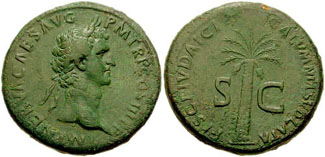
Paul disavows the Jewish custom of circumcision and sides with the Romans under Vespasian, Titus and Domitian, thus creating a theologically acceptable way for his Gentile followers to avoid paying the poll tax.
The Jewish poll tax was instituted by Vespasian to replace the temple tax after the temple was destroyed. Proceeds went instead to the Temple of Capitoline Jupiter in Rome.1 It seems to have continued until the year 362 when it was abolished by the emperor Julian.2
Suetonius reports that under Domitian, the scope of the tax was broadened.
Besides the exactions from others, the poll-tax on the Jews was levied with extreme rigour, both on those who lived after the manner of Jews in the city, without publicly professing themselves to be such, and on those who, by concealing their origin, avoided paying the tribute imposed upon that people. I remember, when I was a youth, to have been present, when an old man, ninety years of age, had his person exposed to view in a very crowded court, in order that, on inspection, the procurator might satisfy himself whether he was circumcised.3
Those who lived after the manner of the Jews would be God-fearers (Gentiles sympathetic to Judaism) or Jewish proselytes and could also be Jewish Christians or just ethnic Jews who didn't want to pay the tax. The distinguishing mark was physical circumcision. Gentile Christians who followed Paul would have been exempt. Paul says,
A person is not a Jew who is one only outwardly, nor is circumcision merely outward and physical. No, a person is a Jew who is one inwardly; and circumcision is circumcision of the heart, by the Spirit, not by the written code. (Romans 2:28-29)
Promoting a promising sect that avoided a tax while reaping all the benefits of its parent religion would have suited the apostles to the Gentiles and their followers. Berger and Lukmann in the Social Construction of Reality explain how this works at the group level.
Frequently an ideology is taken on by a group because of specific theoretical elements that are conducive to its interests. For example, when an impoverished peasant group struggles against an urban merchant group that has financially enslaved it, it may rally around a religious doctrine that upholds the virtues of agrarian life, condemns the money economy and its credit system as immoral, and generally decries the luxuries of urban living. The ideological 'gain' of such a doctrine for the peasants is obvious. Good illustrations of this may be found in the history of ancient Israel.4
Nerva (96-98CE) reduced the severity of the tax collection under Domitian which had the effect of formally exempting Christians.
Notes
1. Wars of the Jews 7.218.
2. Julian, To the Community of the Jews, letter 51.
3. Suetonius, Domitian 12.
4. Berger & Lukmann, 1966, p.141.
This argument posits that Paul's radical rejection of physical circumcision was a pragmatic response to the Fiscus Judaicus---the punitive tax imposed by Vespasian after 70 CE. By redefining Jewishness as an "inward" spiritual state (Romans 2:28-29), Paul provided a legal loophole for his followers. In the eyes of Roman tax procurators, the lack of a physical mark allowed Gentile Christians to retain the prestige of "Ancient Israel's" heritage while avoiding the financial burden of the tax, which funded the Temple of Jupiter Capitolinus.
The argument aligns perfectly with the sociological principle of "ideological gain". Suetonius records the invasive, humiliating physical inspections used by Domitian's officers to identify tax-evaders. Paul's theology of "circumcision of the heart" isn't just abstract mysticism; it is a defensive shield against the Roman state. It explains why a movement deeply rooted in Jewish scripture would so aggressively discard the primary sign of the Covenant: it was a matter of economic and social survival under the Flavians.
The primary weakness is the traditional dating of the Epistles to the 50s CE. If Paul wrote before the war, the Temple Tax was still going to Jerusalem, and the Fiscus Judaicus didn't exist. To accept this theory, one must view the Pauline corpus as a post-70 CE product or heavily redacted to address the new Roman reality.
If the orthodox thesis--that Paul's anti-circumcision stance was purely a pre-war theological debate--were correct, we should see:
• Neutrality toward the State: Paul's letters should ignore the financial consequences of Jewish identity. Instead, we see an obsession with "freedom" from the Law precisely when the Law became a taxable liability.
• Continued Circumcision among Gentile Converts: If there were no tax penalty, more "God-fearers" would likely have fully converted to Judaism. Instead, history shows a massive "pivot" toward Paul's uncircumcised model exactly when being "outwardly" Jewish became expensive.
The anomaly of a "circumcision-free" Judaism makes little sense in the 50s but is an inevitable "social construction" of the 80s.
After robbers, zealots and renegades plundered Jerusalem, dishonoured the temple and killed the eminent citizens, the high priest Ananus (69 CE) predicted the emergence of a new, better religion with Roman sensibilities. Josephus, the Jewish historian, reports that Ananus said,
How then can we avoid shedding of tears, when we see the Roman donations in our temple, while we withal see those of our own nation taking our spoils, and plundering our glorious metropolis, and slaughtering our men, from which enormities those Romans themselves would have abstained? to see those Romans never going beyond the bounds allotted to profane persons, nor venturing to break in upon any of our sacred customs; nay, having a horror on their minds when they view at a distance those sacred walls; while some that have been born in this very country, and brought up in our customs, and called Jews, do walk about in the midst of the holy places, at the very time when their hands are still warm with the slaughter of their own countrymen. For truly, if we may suit our words to the things they represent, it is probable one may hereafter find the Romans to be the supporters of our laws, and those within ourselves the subverters of them.1
Notes
1. Wars of the Jews 4.180--192.
_
This argument identifies a specific historical shift recorded by Josephus, where the High Priest Ananus--amidst the chaos of the Jewish Civil War in AD 69--contrasts the "impious" Jewish rebels with the "orderly" Romans. It suggests that the ideological foundation for a pro-Roman version of Judaism (Christianity) was articulated by the Jewish elite during the war.
The strength of this argument lies in its historical irony. Ananus, the leader of the Jewish provisional government, explicitly suggests that the Romans might eventually become the "supporters of our laws" while the Jewish Zealots are their "subverters." This mirrors the narrative shift found in the New Testament, where Jewish authorities and rebels are depicted as the primary antagonists of the "righteous," while Roman centurions and governors (like Pilate or Cornelius) are often portrayed as sympathetic, disciplined, or recognizing Jesus's divinity. If Ananus spoke these words in AD 69, he was essentially predicting the emergence of a Roman-compatible religion that would preserve Jewish ethics while rejecting Jewish nationalism.
The weakness is that Ananus was likely speaking rhetorically to shame the Zealots, not literally proposing a new religion. His goal was to rally the citizens of Jerusalem to take back the Temple from the "robbers." To see this as a "prediction of Christianity" requires the assumption that the authors of the Gospels--writing after the war--shared Ananus's pro-Roman/anti-Zealot bias and used his logic to frame the life of Jesus.
If the orthodox thesis--that Christianity was a distinct, pro-peace movement founded in AD 30--were correct, we should see:
• A Distinction in Ananus's Speech: If a group of "peace-loving" Christians already existed in Jerusalem in AD 69, Ananus should have pointed to them as the model of piety. Instead, he points to the Romans as the only example of respect for the law.
• Pre-War Roman Sympathy: The Gospels should reflect the political tensions of the 30s. Instead, they reflect the specific post-70 trauma where "the Jews" (as a collective) are blamed for the Messiah's death, while the Roman executioner (Pilate) is depicted as washing his hands of the matter---a narrative that fits the "Romans as supporters of our laws" theme perfectly.
• Ananus as a Character: Interestingly, an "Annas" appears in the Gospels as a villain who judges Jesus. Revisionists might argue this is a literary "payback" or a way to distance the movement from the very elite class that initially shared its pro-Roman sentiments.
Paul's instruction to pray for those in authority (1 Timothy 2:1-2) echoes the moral imperative that Josephus stated in his history of the Jewish Wars.1 It was during that time that certain of the seditious including Eleazar, the son of Ananias the high priest, "persuaded those that officiated in the Divine service to receive no gift or sacrifice for any foreigner." According to Josephus this affront was "the true beginning of our war with the Romans; for they rejected the sacrifice of Caesar." This prohibition was seen as the highest form of impiety. Paul's instruction to the church to pray for Caesar makes more sense if given after the War. He didn't want the church to repeat the mistakes of the past.
Notes
1.Wars of the Jews 2.409.
_
This argument connects the Pauline exhortation to pray for those in authority (1 Timothy 2:1-2) with the specific catalyst of the First Jewish-Roman War: the cessation of sacrifices for the Roman Emperor in AD 66.
The strength of this argument lies in its historical causality. Josephus explicitly identifies the rejection of Caesar's sacrifice by Eleazar and the temple priests as the "true beginning of our war." By refusing to acknowledge the Roman authority through traditional religious ritual, the Jewish state effectively declared war. If the instructions in 1 Timothy (traditionally dated to the early 60s) were actually written after AD 70, they serve as a corrective survival strategy. The author--witnessing the total annihilation of Jerusalem due to this "impiety"--would naturally command the church to pray for kings and authorities to ensure they could lead "a quiet and peaceable life." This transforms a generic moral platitude into an urgent, post-war lesson in political survival.
The weakness is that the pastoral epistles (like 1 Timothy) are often considered by many scholars to be "pseudonymous" (written by a follower of Paul) regardless of the specific "revolt" context. Furthermore, praying for rulers was a common Jewish practice long before the war, as seen in Jeremiah 29:7. A traditionalist would argue Paul was simply maintaining a standard Jewish diaspora ethic to keep the peace in a Roman world.
If the orthodox thesis--that this was written in the early 60s without the war in mind--were correct, we should see:
• A Focus on Persecution: If Paul were writing under Nero's early years, he might be more concerned with specific legal defences. Instead, the focus is on a general liturgical duty to Caesar, which mirrors the very temple service that was halted in AD 66.
• The Absence of "Impiety" Rhetoric: Josephus uses the term "impiety" to describe the rebels' actions. 1 Timothy uses similar language (eusebeia), emphasizing that praying for rulers is "right and is acceptable in the sight of God." This suggests a direct counter argument to the Zealot claim that honouring a foreign king was a sin.
• Contextual Necessity: In the 50s, the "mistake" of the Zealots hadn't happened yet. By placing this instruction in a post-70 setting, the "mistake" is a vivid, horrifying memory of smoking ruins that the Church must avoid repeating.
There is no mention of Paul in Josephus' histories of the Jews. The book Wars of the Jews ends in 75 CE with the death of Catullus, the governor of the Libyan Pentapolis. The book Antiquities of the Jews ends in the 13th year of Domitian or 93 CE.
Josephus was a friend of Herod Agrippa II (c. 28 --c. 95) who was the last client ruler of Rome from the Herodian dynasty. Josephus says that Agrippa wrote 62 letters to him, and "attested to the truth of what I [Josephus] had therein delivered" and that he, Josephus, used this information to compile his history of the Jews. Apparently in one of these letters, Agrippa wrote that he would inform Josephus of a great many things which he didn't know. The emperor Titus as the patron of Josephus also took a keen interest in the contents of the histories.1
In the Acts of the Apostles there is a long interview between this king and the apostle in which Paul is given every opportunity to defend himself and the new religion. (Acts 25:13, 26:32) The date of this interview must have been close to the year 59 when the Roman governor, Porcius Festus arrived in Caesarea to take over as the new procurator of Judea. According to the account in Acts the king expressed a great deal of interest in the philosophy of Paul and the career of Jesus, and Paul in the presence of the king and Festus is alleged to have said:
Indeed the king [Agrippa] knows about these things, and to him I speak freely; for I am certain that none of these things has escaped his notice, for this was not done in a corner. (Acts 26:26)
Despite the alleged clear interest shown by the king in Paul and his theology, and his apparent prior knowledge of the new religion, none of this appears in the history of Josephus, who was the king's friend and confidante.
Despite the silence of Josephus, the Babylonian Talmud, specifically b. Sotah 47, retells the Gehazi story (2 Kings 5) in ways that appear to allude to Paul. Gehazi, the servant of the prophet Elisha, the renegade disciple, traveller to Damascus, the one who "caused the multitude to sin" --maps closely onto Paul, himself a renegade disciple of Gamaliel. The curious linkage of Gehazi's punishment to the laws of unclean food gains polemical force as a reference to Paul's repudiation of Jewish dietary law. Where Josephus may have been silent, the Rabbis of the Babylonian academies seem to have encoded their critique in a biblical narrative.
Notes
1. Josephus, Vita 361--367; Against Apion 1.50--52.
2. Herford, 2006, p.97-103.
_
This argument highlights a profound "conspicuous silence" in the historical record. It contrasts the narrative of Acts of the Apostles, where Paul's trial is a high-profile state event involving the top tier of Roman and Herodian leadership, with the meticulous histories of Flavius Josephus, who fails to mention Paul entirely despite being the close friend and biographer of the very people involved.
The strength of this argument lies in the social proximity of the parties involved. Josephus was not just a distant historian; he was a contemporary and a confidant of Herod Agrippa II. Josephus explicitly states that Agrippa reviewed his work and wrote 62 letters providing insider details for the Antiquities. In Acts, Paul's encounter with Agrippa is portrayed as a pivotal moment where Paul declares that "none of these things has escaped his [the king's] notice." If a charismatic leader of a new religion had indeed stood before the King and the Roman Procurator in a public trial that "was not done in a corner," it is historically improbable that Josephus---writing for a Roman audience about the exact religious tensions of that era---would omit it.
The weakness is the "Argument from Silence." Traditional historians suggest that Paul may have been seen as a minor nuisance or one of many "superstitious" agitators whom Josephus chose to ignore to keep his history focused on political and military figures. However, Revisionists point out that Josephus found space to mention minor rebels, obscure prophets, and even John the Baptist, making his total silence on Paul--the "Apostle to the Gentiles"--highly suspicious.
If the orthodox thesis--that Paul was a famous prisoner of the Roman state in the late 50s CE--were correct, we should see:
• Agrippa's Testimony: In the 62 letters to Josephus, Agrippa should have mentioned the man who almost "persuaded him to be a Christian" (Acts 26:28).
• Roman Legal Records: Josephus, who had access to imperial records through his patrons Vespasian and Titus, should have found mention of a Roman citizen named Paul who appealed to Caesar.
• A Contextual Fit: Josephus details the Jewish-Roman tensions leading up to the war. A movement that claimed a "New King" and was causing riots in Jerusalem (Acts 21) would be central to Josephus's narrative of how the war started.
Jesus says,
Do you think that I cannot appeal to my Father, and he will at once send me more than twelve legions of angels? (Matthew 26:53)
The father-son motif, which is so strong in Christianity, was exemplified for all to see in the Vespasian-Titus partnership.
Church historian Orosius (4th century) declares:
The emperors Vespasian and Titus celebrated their victory over the Jews by a magnificent triumphal entry into Rome. Of all the three hundred and twenty triumphs that had been held from the founding of the City until that time, so fair and strange a sight had not been seen by man---father and son riding in the same triumphal chariot after their glorious victory over those who had offended the Father and the Son.1
The son basks in the glory of the father
... of them the Son of Man will also be ashamed when he comes in the glory of his Father (Mark 8:38)
At the victory parade in Rome,
At daybreak Vespasian and Titus came forth crowned with laurel and clad in the ancient purple robes proper to their family. Next passed a great multitude bearing the representations of Victory, all wrought either in ivory or in gold. After them Vespasian advanced, and Titus followed.2
The son hands out punishments and blessings
For the Son of Man is to come with his angels in the glory of his Father, and then he will repay everyone for what has been done. (Matthew 16:27)
--The Jews are punished by Titus, the son.
Vespasian now turned his attention to what still remained unsubdued in Judaea. He himself, however, hastened to Rome, as winter was now drawing to a close; and, after settling affairs in Alexandria with all speed, he dispatched his son Titus, with a picked force, to the task of crushing Jerusalem.3
--Josephus, the righteous one, receives his reward from Titus, the son.
Titus, who was present with his father, said: 'It is only right, father, that the disgrace attaching to Josephus should be removed together with his chain. For if, instead of loosing, we cut his bonds to pieces, he will be as though he had never been in fetters at all.' Such is the customary treatment of one who has been unjustly bound. Vespasian approving, an attendant came forward and severed the chain with an axe. Josephus, having thus obtained his liberty as the reward of his merits, was now also believed to be a person of credit in his predictions of the future.4
The son copies the father
... the Son can do nothing on his own, but only what he sees the Father doing; for whatever the Father does, the Son does likewise. (John 5:19)
Vespasian accepted their acclamations; but, as they were still eager to prolong them, he made a sign for silence. When complete quiet had been obtained, he rose, drew his cloak over the greater part of his head, and offered up the customary solemn prayers; and the same prayers were offered by Titus.5
The Holy Trinity
Josephus records,
But what, in his [Titus's] own judgment, made the most brilliant spectacle of all was his meeting with his father and the welcome he received from him; yet the citizens as a body felt their keenest delight when they beheld all three together. For not many days later they went forth to meet him, and the city was filled with joy at the sight of the emperor and his two sons.6
And Jesus proclaims,
Go therefore and make disciples of all nations, baptizing them in the name of the Father and of the Son and of the Holy Spirit. (Matthew 28:19)
Notes
1. Orosius, Historiae Adversus Paganos, Book 7.9.
2. Wars of the Jews 7.122-124.
3. Ibid., 4.656-658.
4. Josephus, Vita 428-431.
5. Wars of the Jews, 7.124.
6. Ibid., 7.117.
This argument explores the potential for typological mimesis (imitation) between the Flavian imperial family and the theological structure of the New Testament. It suggests that the Father-Son relationship--the cornerstone of Christian dogma--was physically and politically manifested in the unique co-regency of Vespasian and Titus following their victory in the Jewish War.
The strength of this argument lies in the synchronicity of the imagery. Historical records from Josephus and Orosius emphasize that the Flavian triumph was unique because it featured a father and son sharing the same glory, the same prayers, and the same victory. To a 1st-century subject of the Roman Empire, the most visible "Father and Son" who "repaid everyone for what had been done" (Matthew 16:27) were Vespasian and Titus. The Son (Titus) literally acted as the arm of the Father (Vespasian), doing "whatever the Father does" (John 5:19) in the Judean campaign. Finding these exact motifs in the Gospels suggests that the New Testament writers may have been "Romanizing" the Messianic concept to align with the power structure of the new Flavian dynasty.
The weakness is the theological depth of the Trinity. Orthodox scholars argue that the relationship between God the Father and Jesus the Son is rooted in much older Jewish concepts of the "Word" (Logos) and "Wisdom" (Sophia), which predate the Flavians. They would view the Flavian triumph as a worldly "parody" or a coincidental shadow of a spiritual reality. However, Revisionists argue that the timing is too perfect: the Flavian cult and the Christian cult emerged from the same geographical soil (the Judean War) at the same time.
If the orthodox thesis--that the "Father-Son" theology was fully formed in AD 30--were correct, we should see:
• Resistance to Imperial Language: The early Church should have avoided language that so closely mirrored the specific propaganda of the Flavian "Saviors." Instead, we see the Gospels use terms like Evangelion (Good News), Soter (Savior), and Kyrios (Lord)---all standard titles for the Flavian emperors.
• Separation of Judgment: In a pre-war context, the "judgment" of the Son would be abstract. In the post-70 context, the judgment of the Son (Titus) upon the Jews was a physical, historical fact.
• A Non-Flavian Trinity: If the Trinity was independent, why does Josephus emphasize the "brilliant spectacle" of the three together (Vespasian, Titus, and Domitian) as the specific source of the city's joy, mirroring the baptismal formula of the Father, Son, and Holy Spirit?
Josephus says,
A further multitude of about six thousand, consisting of a miscellaneous crowd of women and children and a mixed body of others, had fled for refuge to the last surviving portico of the outer court. Before the Caesar [Titus] had reached any decision or given any orders to the officers concerning these people, the soldiers, carried away by their fury, set fire to the portico1 from below; with the result that some in their attempts to escape the flames were killed by leaping out, while others were consumed in the fire; of all that multitude not a soul escaped. The cause of their destruction was a certain false prophet, who had on that day made a public proclamation in the city, that God commanded them to go up to the Temple, there to receive the signs of their deliverance.2
In Acts we read:
When the day of Pentecost had come, they were all together in one place. And suddenly from heaven there came a sound like the rush of a violent wind, and it filled the entire house where they were sitting. Divided tongues, as of fire, appeared among them, and a tongue rested on each of them. All of them were filled with the Holy Spirit and began to speak in other languages, as the Spirit gave them ability. (2:1-4)
If Josephus, being a devout Jew, mentioned Christians at all we would expect him to describe them as following a false prophet and this is what we find. Note the elements common to each narrative: an ethnically diverse multitude, a charismatic leader, a house, a fire, prophecy, "deliverance"---remarkably in Josephus as the source of a myth. This, the defining moment when Christianity was energised, the primitive Christians recast as triumph, denied their agony and reimagined the horror as the manifest outpouring of God's spirit. The unnamed false prophet who survived the catastrophe was Cephas, alias Peter.
Notes
1. The Portico of the Temple is also recorded in Acts as being the favourite haunt of Peter and the new sect of the Christians. (3:11, 5:12)
2. Wars of the Jews 6.280-283.
This argument proposes a radical re-contextualization of Pentecost, suggesting that the "outpouring of the Holy Spirit" in Acts 2 is a sanitized, theological reimagining of a horrific event recorded by Josephus. It posits that the "tongues of fire" were not divine gifts, but the literal flames of the Roman siege.
The strength of this argument lies in the striking parallels in imagery and setting. Both accounts feature a "multitude" of diverse people gathered in a single "house" (or portico) in Jerusalem, awaiting a divine sign of deliverance. Josephus specifically mentions a "false prophet" who led 6,000 people to the Temple to "receive the signs of their deliverance," only for them to be consumed by fire. Revisionists argue that the "Divided tongues, as of fire" in Acts is a poetic transformation of the "fury" of the Roman soldiers setting the structure ablaze. By turning a literal catastrophe into a spiritual triumph, the early Church could maintain that their "deliverance" had occurred, even as their physical headquarters was reduced to ash.
The weakness is the Traditionalist Chronology. Acts places Pentecost in the year 33 CE, while the massacre at the Temple portico occurred in 70 CE. To accept this theory, one must believe that the author of Acts (writing decades later) deliberately "backdated" the defining trauma of the Jewish War to the beginning of the movement to create a foundation myth. Traditionalists also point out that Pentecost is a Jewish harvest festival (Shavuot), providing a natural liturgical context for the Acts narrative that predates the Roman war.
If the orthodox thesis--that Pentecost was a peaceful spiritual event in 33 CE--were correct, we should see:
• A Lack of Fire Imagery elsewhere: Why use the specific, terrifying imagery of "tongues of fire" resting on people? In the ancient world, fire in a crowded building almost always signalled a death sentence.
• A Flourishing "Holy Spirit" movement before 70 CE: If the Spirit was poured out in 33 CE, the movement should have been "energized" and highly visible for the next 40 years. Yet, as noted in the "Prophetic Vacuum" (Point 48), there is a strange silence in history regarding this movement until after the war.
• Josephus mentioning a different "Spirit" event: Josephus is meticulous about Jewish religious phenomena. If a massive, public miracle involving thousands of people speaking in tongues happened in 33 CE, it is odd that he ignores it but records a strikingly similar fiery event in 70 CE.
Suetonius says that Domitian,
Upon his first succeeding to power, he felt such an abhorrence for the shedding of blood, that, before his father's arrival in Rome, calling to mind the verse of Virgil, 'Began to feast on flesh of bullocks slain,' he designed to have published a proclamation, 'to forbid the sacrifice of oxen.'1
The teachers of the new religion had said that Jesus's death put an end to the Temple sacrifices. Paul says,
They [the believers] are now justified by his grace as a gift, through the redemption that is in Christ Jesus, whom God put forward as a sacrifice of atonement by his blood. (Romans 3:24-25)
The writer to the Hebrews declared that the cult of temple animal sacrifices had been discharged in the shedding of the blood of one man, Jesus. "It is impossible for the blood of bulls and goats to take away sins." (Hebrews 10:4)
The Old Testament prophets could also be quoted to support this idea.
I hate, I despise your festivals, and I take no delight in your solemn assemblies. Even though you offer me your burnt offerings and grain offerings, I will not accept them; and the offerings of well-being of your fatted animals I will not look upon. (Amos 5:21-22)
It is significant that the opinion of the emperor agreed with a basic tenet of the new religion. No doubt there were others in the empire who shared the views of the emperor. Whatever the extent of the feeling or the changes in sacrificial procedures, Christianity would benefit; the arguments of the apostles would make more sense in this new social environment. Note that Domitian had this proclamation in mind before his father Vespasian came to Rome. That would have been in the year 70.
Notes
1. Virgil, Georgics 2.537; Suetonius, Domitian 9.
_
This argument identifies a surprising alignment between the personal ethics of the Emperor Domitian (reigned 81-96 CE) and the core theology of Christianity. It suggests that the Christian rejection of animal sacrifice was not an isolated Jewish heresy, but part of a broader "spirit of the age" in Rome that favoured a more "bloodless" or spiritualized form of worship--a sentiment shared by the head of the Roman state himself.
The strength of this argument lies in the chronological and cultural proximity. Suetonius records that Domitian, as early as 70 CE (the same year the Temple was destroyed), contemplated a ban on the sacrifice of oxen because he found the shedding of blood abhorrent. This "abhorrence" perfectly mirrors the arguments in the Book of Hebrews, which claims that the blood of bulls and goats is ineffective and has been superseded by a single, final sacrifice. If the Roman Emperor was moving toward a ban on animal sacrifice at the exact moment the Jewish Temple was burned, the Christian argument for a "Bloodless Sacrifice" (the Eucharist) would have found a highly receptive audience within the Roman aristocracy and the imperial household.
The weakness is that Domitian's ban was motivated by agrarian economics and Virgil's poetry, not necessarily a theological shift toward Messianism. He wanted to preserve the population of working oxen for farming. Furthermore, despite his early hesitation, Domitian eventually embraced the traditional Roman cult, including sacrifices, to bolster his image as Dominus et Deus (Lord and God).
If the orthodox thesis--that the end of sacrifice was a purely internal Jewish-Christian revelation from 30 CE--were correct, we should see:
• Roman Resistance: The Romans, who viewed animal sacrifice as the "glue" of the state, should have been outraged by Christian anti-sacrifice rhetoric. Instead, we find the future Emperor (Domitian) having the exact same "anti-blood" impulses in 70 CE.
• Theology Detached from Events: The anti-sacrifice theology of Hebrews and Paul should appear in the 30s or 40s. However, the most sophisticated arguments against sacrifice (Hebrews) appear in a text most scholars agree was written in the shadow of the Temple's 70 CE destruction — exactly when Domitian was considering his ban.
• A "Non-Roman" Gospel: The Gospels would likely emphasize a return to the Temple if they were written in the 30s. Instead, they emphasize a "Temple of the Spirit," which conveniently aligns with a Roman world that was becoming increasingly uncomfortable with the gore of the slaughter-altar.
Paul's attitude to the Mosaic Law is more easily understood if we suppose that it was shaped by the events of 66-70.
Paul says that:
--those under the Law lack freedom (Romans 7:25);
--those under the Law are under a curse (Galatians 3:10);
--the Law brings the wrath of God (Romans 4:15);
--the Law brings death (2 Corinthians 3:7);
--the Law provokes sin (Romans 5:20);
--the Law locks people up (Galatians 3:23).
These things happened in the seminal period of the insurrection due to the Jew's stubborn insistence on keeping the letter of the Law. The Christian texts say that God "abolished the law with its commandments and ordinances" (Ephesians 2:14). Furthermore, says Paul:
... Christ is the end of the law (τέλος νόμου) so that there may be righteousness for everyone who believes. (10:4)
By an act of God through the agency of the Romans, any possibility of the fulfillment of the ritual requirements of the Law ended dramatically in 70 CE. Christ as the telos (goal/culmination/endpoint) of the Law explained why faith succeeded where works failed---especially poignant when sacrifices ceased. Early church readings (e.g., patristic echoes in Augustine and others) emphasized this as righteousness by faith alone, free from obsolete rituals.
_
This argument proposes that the radical "Anti-Law" theology of the Apostle Paul is not a theoretical debate about legalism, but a post-war rationalization of a historical reality. It suggests that Paul's letters describe the Law as a "curse" and a source of "death" because he witnessed the Law's final, violent collision with the Roman Empire in 70 CE.
The strength of this argument is its explanatory power regarding Paul's extreme rhetoric. For a Jew in the 30s CE, the Law was "light" and "life" (as seen in the Psalms). Why would Paul suddenly call it a "ministry of death" (2 Corinthians 3:7) unless the Law had literally led the nation to its doom? In the years 66--70, it was the "stubborn insistence" on the letter of the Law (Sabbath laws, Temple purity, refusal of Roman imagery) that fuelled the zealotry that led to the total massacre of the Jewish people. When Paul says Christ is the telos (endpoint) of the Law, he is providing a theological escape hatch for survivors: the Law didn't just "fail"---it finished, replaced by a "righteousness of faith" that didn't require a physical Temple or a political state.
The weakness is the internal timeline of the Epistles. Paul often discusses the Law in relation to circumcision and dietary habits, which were still very much a part of Jewish life after 70 CE. Traditionalists argue that Paul's conflict was with "Judaizers" within the church, not a reaction to the Roman siege. However, Revisionists note that the emotional weight Paul gives to the Law's failure matches the national trauma of 70 CE far better than a local argument over food.
If the orthodox thesis--that Paul wrote in the 50s CE while the Temple was standing and the Law was flourishing--were correct, we should see:
• A Hope for Temple Reform: Paul should discuss the Temple as a place for potential renewal. Instead, he treats the "old covenant" as something obsolete and "vanishing away" (Hebrews 8:13), language that fits a post-70 reality.
• Milder Language: If the Law hadn't yet led to 1.1 million deaths (per Josephus), calling it a "curse" would be an incomprehensible insult to his audience. After the war, that "curse" was visible in every charred stone of Jerusalem.
• No Link to "Wrath": Paul says the Law "brings wrath" (Romans 4:15). In the 1st century, "The Wrath" was a specific technical term used by Jews and Christians alike to describe the Roman destruction of Judea.
Peter says:
. . . like living stones, let yourselves be built into a spiritual house, to be a holy priesthood, to offer spiritual sacrifices acceptable to God through Jesus Christ. (1 Peter 2:4-5)
Paul says:
Do you not know that you [plural] are God's temple and that God's Spirit dwells in you [plural]? (1 Corinthians 3:16)
... and
So then you [Gentiles] are no longer strangers and aliens, but you are citizens with the saints and also members of the household of God, built upon the foundation of the apostles and prophets, with Christ Jesus himself as the cornerstone. In him the whole structure is joined together and grows into a holy temple in the Lord; in whom you also are built together spiritually into a dwelling place for God. (Ephesians 2:20-21)
The idea that the believers metaphorically fulfilled the functions of stones in a new temple would have more easily arisen after the stones of the physical temple had been thrown down in the year 70.
_
This argument identifies a specific shift from physical architecture to human metaphor. It suggests that the New Testament's insistence that believers are "living stones" in a "spiritual temple" is not a mystical abstraction, but a direct response to the literal destruction of the Herodian Temple in 70 CE.
The strength of this argument lies in the psychological necessity of the metaphor. For hundreds of years, the Jewish relationship with God was mediated by a physical building of stone and mortar. When Titus's legions literally left "not one stone upon another" (Matthew 24:2), the religion faced an existential crisis. The theology of 1 Peter and Ephesians provides the solution: the Temple isn't gone; it has merely changed its "state of matter" from mineral to human. By calling Christ the "cornerstone" and believers the "living stones," the authors provide a way for the religion to survive without a geographic center. This move from a localized Temple to a portable, human Temple is the precise innovation needed to transition from a national cult to a global Roman religion.
The weakness is that similar "spiritual temple" language appears in the Dead Sea Scrolls (Qumran), written before the Temple was destroyed. The Essenes viewed their community as a "holy house" because they believed the current Jerusalem priesthood was corrupt. Traditionalists argue that the early Church simply adopted this existing sectarian language. However, Revisionists point out that what was a fringe metaphor for the Essenes became the central pillar of Christianity only after the physical Temple ceased to exist.
If the orthodox thesis--that this "spiritual temple" was fully conceptualized while the physical one was still standing--were correct, we should see:
• Temple-Centric Rituals: Early Christian letters should include instructions on how to behave at the physical Temple in Jerusalem. Instead, the New Testament focuses almost exclusively on the "Body of Christ" as the only relevant sacred space.
• A Co-existence Plan: There would be a theological "blueprint" for how the spiritual temple and the physical temple work together. Instead, the New Testament treats the physical stones as obsolete, "shadowy" things that are "fading away" (Hebrews 8:13).
• Archaeological Context: If this was a pre-70 idea, why did it only become the dominant identity of the movement after the Roman "Spirit of Burning" (Point 55) cleared the site? The metaphor is an obituary for the stones of Herod.
The destruction of the temple and the Sanhedrin in 70 CE left a prophetic vacuum that needed to be filled. Ananus, the good high priest had been murdered. The prophetic vacuum was filled theologically by "Jesus."
Justin Martyr in his argument with the Jews asserts that,
But after the manifestation and death of our Jesus Christ in your nation, there was and is nowhere any prophet: nay, further, you ceased to exist under your own king, your land was laid waste, and forsaken like a lodge in a vineyard.1
A parallel situation had occurred 200 years before. In the first Book of Maccabees, we read,
So they tore down the altar, and stored the stones in a convenient place on the temple hill until a prophet should come to tell what to do with them. (4:46)
The Jews and their priests have resolved that Simon should be their leader and high priest forever, until a trustworthy prophet should arise. (14:41)
Notes
1. Dialogue with Trypho 52.
_
This argument identifies the destruction of the Temple and the Sanhedrin in AD 70 as a catastrophic rupture in Jewish religious authority--a "prophetic vacuum" that left the nation without a divine voice or legal center. It suggests that the figure of "Jesus" was theologically constructed to fill this void, providing a permanent high priest and prophet when the earthly ones were gone.
The strength of this argument lies in its historical typology. As seen in the Maccabean era (c. 164 BCE), Judaism had a precedent for "holding patterns": when the Temple was defiled and the true priesthood was in doubt, the people operated under temporary leadership "until a trustworthy prophet should arise." In AD 70, the crisis was even more absolute--the High Priest Ananus was murdered, and the physical altar was not just defiled, but erased. Justin Martyr captures this reality perfectly by noting that after the "death of Jesus," prophecy ceased in Israel and the nation was "laid waste." From a revisionist perspective, Jesus is the "trustworthy prophet" who finally "arrived" in the mid-to-late first century to provide a theological solution for why the Temple was gone and why no new prophets were appearing.
The weakness is the causal direction. Traditional scholars argue that the "prophetic vacuum" was recognized by Christians because Jesus had already replaced the Law and Prophets decades earlier. In this view, AD 70 was merely the physical confirmation of a spiritual transition that began in AD 30. However, the revisionist view holds that the "vacuum" of AD 70 was the cause, and the high-priestly theology of Jesus (especially in the Book of Hebrews) was the effect.
If the orthodox thesis--that Jesus fulfilled the prophetic office in AD 30--were correct, we should see:
• Overlap of Authority: There should be a period where Jesus's "new" prophecy and the "old" Temple prophecy functioned alongside each other without conflict. Instead, Justin Martyr explicitly links the disappearance of Jewish prophets to the specific moment the land was "laid waste" (AD 70).
• Earlier High-Priestly Theology: If Jesus was the "Permanent High Priest," this doctrine should be the cornerstone of the earliest layers of the faith. Instead, we see it fully developed in the Book of Hebrews, a text that most scholars agree was written specifically to address the trauma of a disappearing or recently destroyed Temple.
• Maccabean Resolution: If the "Trustworthy Prophet" predicted in 1 Maccabees appeared in AD 30, the Jewish nation should have transitioned then. Instead, the "holding pattern" of the Maccabees seems to have continued until the total collapse of AD 70 forced a new theological invention.
Was there a forty-year delay between the killing of Christ and the punishment of the Jews? The writer of the second book of Maccabees says this is not how God deals with his people. In referencing recent events in the second century BCE, he says,
Now I urge those who read this book not to be depressed by such calamities, but to recognize that these punishments were designed not to destroy but to discipline our people. In fact, it is a sign of great kindness not to let the impious alone for long, but to punish them immediately. For in the case of the other nations the Lord waits patiently to punish them until they have reached the full measure of their sins; but he does not deal in this way with us, in order that he may not take vengeance on us afterward when our sins have reached their height. (6:12-15)
_
This argument challenges the traditional 40-year gap between the death of Jesus (c. AD 30) and the destruction of Jerusalem (AD 70). It uses the theological logic of 2 Maccabees to suggest that in the Jewish worldview, divine punishment for the "Holy People" is immediate, not delayed.
The strength of this argument lies in its cultural and theological consistency. The author of 2 Maccabees explicitly states that while God is patient with "other nations," He punishes Israel immediately to prevent their sins from reaching an irredeemable height. If the killing of the Messiah was the ultimate "stumbling block" (as per Maimonides in Point 42), the Jewish theological expectation would be an immediate strike from heaven. A 40-year delay (nearly two generations) contradicts the "great kindness" described in Maccabees. From a Revisionist perspective, this implies that the "sin" (the death of Jesus) and the "punishment" (the War of 70 CE) were likely the same historical event, later separated by decades in the canonical timeline to fit a prophetic scheme.
The weakness is the counter-example of the Wilderness. Traditionalists point to the Exodus, where Israel was forced to wander for exactly 40 years before entering the land as punishment for their lack of faith. They argue that the 40-year gap between AD 30 and AD 70 was a deliberate "New Exodus" period, giving the nation a generation to repent. However, the Maccabean text suggests a different tradition--one where delayed punishment is a sign of God's abandonment, not his mercy.
If the orthodox thesis--that there was a 40-year window of grace--were correct, we should see:
• A Consistent "Grace Period" Theology: The New Testament writers should highlight the delay as a sign of God's patience. Instead, Jesus in the Gospels often warns that "this generation" (genea) will not pass away before these things happen, implying a sense of imminence that matches the Maccabean "immediate punishment" model.
• A Historical Precedent for Delayed Vengeance: In most Judean historiography, national calamities (like the Babylonian exile or the Hellenistic persecution) are linked directly to the immediate sins of the current leadership, not the sins of their grandfathers.
• The Absence of a 40-Year Schema: If the gap were a historical reality, it wouldn't match the "40-year" biblical trope so perfectly. The precision of the 40-year wait (AD 30 to 70) looks more like a literary construction designed to mirror the Wilderness wandering than a chronological fact.
There was not a total massacre of the besieged in Jerusalem as Titus sold many into slavery and spared some 40,000 "whom Caesar let go whither every one of them pleased."1
In the continuation of the passage from the prophet Joel quoted by Peter in Acts 2:17-20, we read,
Then everyone who calls on the name of the Lord shall be saved; for in Mount Zion and in Jerusalem there shall be those who escape, as the Lord has said, and among the survivors shall be those whom the Lord calls. (Joel 2:32)
The Jewish believers naturally would have read themselves into the prophecy as the survivors whom the Lord had called, and their physical baptism by fire did indeed empower the new religion. As Isaiah prophesied,
Whoever is left in Zion and remains in Jerusalem will be called holy, everyone who has been recorded for life in Jerusalem, once the Lord has washed away the filth of the daughters of Zion and cleansed the bloodstains of Jerusalem from its midst by a spirit of judgment and by a spirit of burning. (Isaiah 4:3-4)
Notes
1. The Jewish War 6.403--406.
_
This argument connects the specific survival of the 70 CE siege to the prophetic expectations of the early Church. It suggests that the "Jewish Christians" were not a pre-war sect, but rather the literal survivors of the Roman massacre who interpreted their escape as a divine calling.
The strength of this argument lies in its historical and scriptural alignment. Josephus records a specific group of 40,000 survivors whom Titus allowed to go "whither every one of them pleased." These individuals would have been in a state of profound psychological and religious shock. By looking at Joel 2:32--the very passage Peter quotes at Pentecost in Acts 2--we find a promise that "in Jerusalem there shall be those who escape... among the survivors shall be those whom the Lord calls." The revisionist thesis suggests that the "baptism by fire" mentioned in the Gospels was not a metaphor for the Holy Spirit, but the literal "spirit of burning" (Isaiah 4:4) that consumed Jerusalem in 70 CE.
The weakness is the orthodox chronological framework. Traditional scholarship insists that the "survivors" in Joel were interpreted by Christians as those "saved from sin" decades before the war. To accept this point, one must view the Book of Acts not as a history of the 30s, but as a post-war narrative where the "Pentecost" experience is a theological processing of the survival of the Roman war.
If the orthodox thesis--that the Church was fully formed by AD 33--were correct, we should see:
• Separation of "Salvation" and "Siege": The early believers would not need to anchor their identity in the "remnant" that escaped a burning city. Yet the New Testament is saturated with the language of a "remnant" saved out of a larger destruction.
• Incongruent Prophecy: If the "Day of the Lord" happened in AD 30, why does the prophecy in Joel 2:32 specifically emphasize survival in Mount Zion after a "spirit of judgment"? This fits a post-70 context where a small group of Jews survived the total annihilation of their peers.
• A Non-Violent Baptism: If "baptism with fire" was purely spiritual, why did it coincide with the literal "cleansing of bloodstains... by a spirit of burning" described in Isaiah 4:4? The revisionist view sees the fire of 70 CE as the "womb" of the new religion.
The earliest and most reliable sources---Codex Sinaiticus and *Codex Vaticanus*---omit the name "Hagar". The verse then reads:
For Sinai is a mountain in Arabia and corresponds to the present Jerusalem, for she is in slavery with her children.
Both words, Sinai and Jerusalem, represent actual geographical localities. Paul's argument relies on a direct conceptual link between the literal mountain of the Law (Sinai) and the literal beloved city set on a hill (Jerusalem). If we accept that the letter was written post AD 70 then by that time Jerusalem had been reduced to a Roman military outpost. The "slavery" Paul mentions is not just spiritual; it refers directly to the 97,000 Josephus records being led away in chains.1 The passage has echoes in Matthew 23:37-38, where Jesus is made to say:
Jerusalem, Jerusalem, the city that kills the prophets and stones those who are sent to it! How often have I desired to gather your children together as a hen gathers her brood under her wings, and you were not willing! See, your house is left to you, desolate.
"When the plain sense of Scripture makes common sense, seek no other sense; therefore, take every word at its primary, ordinary, usual, literal meaning unless the facts of the immediate context, studied in the light of related passages and axiomatic and fundamental truths, indicate clearly otherwise."2
Notes
1. Wars of the Jews 6.420.
2. "Rule 3: The Golden Rule of Interpretation" in The Science of Interpreting Scripture (Biblical Research Society publications) accessed at [Biblical Research Studies Group-The Golden Rule of Interpretation](https://www.biblicalresearch.info/page55.html)
This argument utilizes the "Golden Rule of Interpretation"--taking the text at its primary, literal meaning--to anchor the Epistle to the Galatians in the post-70 CE landscape. By following the superior manuscript evidence of Codex Sinaiticus and Codex Vaticanus, which omit the allegorical name "Hagar", the verse links the physical desolation of Mount Sinai in the Arabian desert directly to the "present Jerusalem." The "slavery" described is not merely a theological metaphor for the Law, but a literal reference to the 97,000 Jewish captives Josephus records being led away in Roman chains after the city's fall.
The strength of this view is its historical realism. It transforms a difficult Pauline metaphor into a sharp, contemporary observation. In the 50s CE, Jerusalem was a thriving, sovereign-leaning metropolis; describing it as "in slavery with her children" would have seemed like an eccentric exaggeration. However, after 70 CE, with the city transformed into a camp for Legio X Fretensis and its population sold into the slave markets of the Empire, the description becomes a literal, heartbreaking fact. The linguistic "correspondence" (systoichei) between a desert mountain (Sinai) and a ruined city (Jerusalem) perfectly captures the "topographical obituary" of the Jewish state.
The primary weakness is the traditional reliance on the "Hagar/Sarah" allegory. If "Hagar" is included (as in later manuscripts), the text remains firmly in the realm of Rabbinic-style midrash rather than political commentary. Critics also argue that Paul uses "slavery" throughout his letters to describe the spiritual yoke of the Mosaic Law, making a literal reference to Roman prisoners unnecessary to his theological point.
What we should see If the orthodox thesis--that Paul wrote this in the 50s CE--were correct, we should see:
• Political Nuance: Paul would likely distinguish between the spiritual "bondage" of the Law and the physical "freedom" of the then-prosperous Jerusalem.
• A Different "Present Jerusalem": The text would likely refer to the "present Jerusalem" as a seat of power or a source of persecution (as it is in Acts), rather than a site of total, pathetic enslavement.
• Manuscript Uniformity: We would expect the earliest manuscripts to include "Hagar" to make the allegory work; instead, the most authoritative codices present a stark, literal comparison between two desolate locations.
If the Law was given at Sinai and its final execution centred in Jerusalem, the destruction of the city proved that the "mountain" of the Law led only to bondage and death. Paul identifies the "present Jerusalem" as a desolate ruin, identifying it with the desert mountain of Sinai to tell the survivors that they must look "above" for their citizenship (v.26). The earthly city has been "cast out" like Hagar leaving the People of the Way to find their spiritual identity in a new dispensation.
According to the Acts of the Apostles early Christians called themselves people of the Way. Regarding the use of the term, Skarsaune and Hvalvik make the following observations:
The way (ἡ ὁδός): This was evidently the term the first Jewish Christians used for their form of Judaism. The absolute usage occurs five times in Acts (9:21; 19:9,23; 24:14,22; cf. 22:4: "this Way") where we also find "the Way of the Lord" (18:25) and "the Way of God" (18:26).2
It seems likely that this term would have gained currency in the aftermath of the War as it could be linked to key prophecies which cited Jerusalem's punishment and its conclusion. Isaiah, for example, proclaims:
Speak tenderly to Jerusalem, and cry to her that she has served her term, that her penalty is paid, that she has received from the Lord's hand double for all her sins. A voice cries out: 'In the wilderness prepare the way of the Lord3, make straight in the desert a highway for our God.' (40:2-3)
Truly, O people in Zion, inhabitants of Jerusalem, you shall weep no more. He will surely be gracious to you at the sound of your cry; when he hears it, he will answer you. Though the Lord may give you the bread of adversity and the water of affliction, yet your Teacher will not hide himself anymore, but your eyes shall see your Teacher4. And when you turn to the right or when you turn to the left, your ears shall hear a word behind you, saying, 'This is the way; walk in it.' (30:19-21)
The affliction of the Jews ended in the year 70. The Teacher who appeared was imagined to be Jesus,5 and the new religion based on his teaching was called the Way.
Notes
1. For example; "...any who belonged to the Way..."
2. Skarsaune & Hvalvik, 2007, p.56.
3. τὴν ὁδὸν κυρίου in the LXX.
4. The Masoretic Text reads a singular "teacher" (מוריך môreykā) not the plural "those who mislead" found in the LXX.
5. For example: Matthew 23:8, "But you are not to be called rabbi, for you have one teacher (διδάσκαλος) and you are all brothers."
_
This argument examines the earliest self-designation of the Jesus movement--- "The Way" (hē hodos)---and suggests that this title was not a generic metaphor for a lifestyle, but a specific theological claim born from the aftermath of the 70 CE destruction.
The strength of this argument is its exegetical grounding in the Hebrew Bible. For a Jew living in the ruins of post-70 Jerusalem, the "Way of the Lord" from Isaiah 40 was not an abstract concept; it was a promise that began only after Jerusalem had "served her term" and "her penalty is paid." The penalty was the destruction of the city. Therefore, the "Way" could only truly be prepared once the "spirit of burning" (Point 55) had completed its work. By calling themselves "People of the Way," the early believers were identifying as the "remnant" for whom the desert highway was finally being opened.
The weakness is the New Testament chronology. The book of Acts places the use of "The Way" in the 30s and 40s CE (Acts 9:2). Traditionalists argue that the "penalty" Isaiah spoke of was the Babylonian Exile, and the "Way" was the spiritual path opened by Jesus's ministry. However, the Revisionist view notes that the language of Isaiah 30:20--linking the "bread of adversity" and "water of affliction" to the sudden appearance of a Teacher--matches the specific experience of the 70 CE survivors far more closely than the relatively stable period of the 30s CE.
If the orthodox thesis--that "The Way" was a pre-war title--were correct, we should see:
• Alternative Prophetic Anchors: The movement might have called itself "The Kingdom" or "The New Covenant" primarily. Instead, they chose a term (hē hodos) that is explicitly tied in Isaiah to the comfort of Zion after a great catastrophe.
• Consistency in the LXX: The Greek term used in Acts is the exact phrase used in the Septuagint (LXX) for the "Way of the Lord" in Isaiah 40. This suggests the title was adopted by people specifically looking for the "comfort" promised after Jerusalem's ruin.
• A Hidden Teacher: Isaiah 30 promises that "your Teacher will not hide himself anymore." If Jesus was public and famous in the 30s, this prophecy makes little sense. But if "Jesus" was a theological figure emerging from a "prophetic vacuum" (Item 48) after the war, then the "Teacher" appearing to the eyes of the survivors is a perfect fit.
Berger, P. L., & Luckmann, T. (1966). The social construction of reality: A treatise in the sociology of knowledge. Garden City, N.Y: Doubleday.
Herford, R. T. (2006). Christianity in Talmud and midrash (Augmented ed). Ktav Pub. House Inc.
Maccoby, H., Nahmánides, Yehiel, & Salomón, I. V. (2006). Judaism on trial: Jewish-Christian disputations in the Middle Ages. Oxford: Littman Library of Jewish Civilization.
Metzger, B. M. (1987). The canon of the New Testament : its origin, development, and significance. Clarendon Press; Oxford University Press.
Puin, G. R., & Ohlig, K.-H. (2010). The hidden origins of Islam: New research into its early history. Amherst Nueva York: Prometheus Books
Richardson, P., & Shukster, M. B. (1983). Barnabas, Nerva, and the Yavnean Rabbis. The journal of theological studies, 34(1), 31-55.
Shannon, K. (2012). Memory, religion and history in Nero's great fire: Tacitus, "Annals" 15.41---7. The Classical Quarterly, 62(2), 749-765.
Skarsaune, O., & Hvalvik, R. (2007). Jewish believers in Jesus: The early centuries. Peabody, Mass: Hendrickson Publishers.
Syon, D. (2014). Gamla III : the Shmarya Gutmann Excavations, 1976-1989, finds and studies (1st ed.). Israel Antiquities Authority.

About This Work
Paul George holds a Bachelor of Arts (Honours) in Classics and Ancient History from the University of Western Australia, awarded in 2025. His undergraduate dissertation, "Tiberius to Titus: Redating and Reassessing the Origins of Christianity," forms the academic foundation of this website. He also holds a Master's Degree in Education (ESL) from Edith Cowan University.
“The question of Christian origins is not, for me, an abstract one. I spent a decade as a practising Christadelphian, followed by several years in evangelical Christianity — communities in which the historical foundations of the faith were not merely assumed but treated as beyond examination. It took the force and clarity of the New Atheism, and the four horsemen in particular, to reawaken in me the question I had long suppressed: where did this actually come from?
What followed was years of reading, argument, and gradual reconstruction. The academic confidence to pursue that question with proper rigour came from an unexpected direction — a Master’s degree in ESL and linguistics, which taught me to read texts carefully, to interrogate sources, and to resist the pull of received interpretation. Those habits of mind turned out to be exactly what the origins question required.
This thesis is the result. It is the work of an atheist who takes religion seriously — seriously enough to ask, without sentiment or apology, how it was actually made.”
Get in Touch
For academic correspondence, media enquiries, or to request access to the full thesis, please get in touch.
paul@ad70.com.auFrequently Asked
The Academic Foundation
Tiberius to Titus: Redating and Reassessing the Origins of Christianity — Bachelor of Arts (Honours), Classics and Ancient History, University of Western Australia, 2025.
↓ Read the Dissertation (PDF)